Wednesday, June 1, 2011

Late Spring Butterflies

Summer is known as the best time of year for butterfly diversity. With warm temperatures and blooming flowers (e.g. joe-pye-weed, beebalm, and milkweeds), butterflies can be extremely abundant. During this time, the species diversity of butterflies is very high; in mid-July, it is not uncommon to easily find 20-30 butterfly species in a single meadow. As a result of this high diversity and abundance of brightly-colored species, many "butterfliers" wait until this prime time to go looking for these insects.

Although summer is often considered the best season for butterflies, many unique species show up around late spring. Many of these species only fly for a short time period, so by the time the summer butterflies emerge, these interesting spring species are no longer around. Unlike summer, where large, flower-filled meadows and gardens seem to be hotspots, spring butterflies prefer woodlands and grassy meadows or shrubby areas.

A meadow with warm-season grasses, greenbrier (Smilax), and meadowsweet (Spiraea) is perfect for spring butterfles.

The only downside to finding butterflies during the spring is that they rarely sit still. Since there are few flowers blooming for the butterflies to get nectar, the butterflies do not sit still for very long. However, if flowers such as northern dewberry (Rubus flagellaris) are blooming, the butterflies may congregate around the flowers.

Here are some interesting late spring butterfly species that are currently are flying or will be emerging very soon. If you see these species, please report them to the Eastern Pennsylvania Phenology Project.

Many of the common spring butterflies are classified as "skippers" a group of small, plain butterflies that are commonly found in grassy areas. The butterfly pictured above is a duskywing, which is a type of skipper. This species is most likely a Wild Indigo Duskywing, a common species of open areas. However, there is the possibility that this is a Columbine Duskywing, a little-known species that is virtually identical to the Wild Indigo. Due to the fact that these species are so similar, it is possible that the Columbine Duskywing, although considered rare now, may be more common than researchers currently know. These Wild Indigo-type Duskywings are just beginning to emerge in northeastern Pennsylvania.


This butterfly, a Dreamy Duskywing, is a common butterfly of late spring and early summer. As a caterpillar, Dreamy Duskywings eat the leaves of birches, aspens, and willows, so the adults are commonly found in open meadows or fields near forests where these trees grow. Unlike Wild Indigo Duskywings, a fairly large skipper, Dreamy Duskywings are very small and often avoid detection due to this size as well as their quick flight. This species is very similar to the Sleepy Duskywing, a species that flies a few weeks earlier and is mostly gone by the time Dreamy Duskywings emerge.

Another "large" skipper is the Northern Cloudywing. The cloudywing is similar to the duskywings, but has a different wing shape, often sits with its wings partway open (whereas duskywings often sit with wings fully opened), and does not have as much patterning on the wings. This species can be found in woodlands or open areas. Although this species will begin to emerge during the coming weeks, it will stick around throughout part of the summer.

Yet another brown skipper, the Cobweb Skipper is a very interesting late-spring species. Unlike the previously mentioned species, the Cobweb Skipper belongs to a group of skippers known as grass skippers, a large group of small butterflies. While many of these species are found throughout the summer, some species (including the Cobweb) only occur for a few weeks in late May and early June. The Cobweb Skipper relies on bluestem grasses (Andropogon and Schizachyrium), so it is almost always found in fields or meadows where these plants grow. Unfortunately, good meadows with these necessary grasses are being lost to development, and the butterfly population is falling as well. Although this species can be quite common at a good location, such locations can be difficult to find.

Indian Skipper
Indian Skippers are often found in the same places as Cobweb Skippers: upland meadows with bluestem grasses. The Indian Skipper also only occurs for a few weeks around the end of May and the beginning of June. This species is also declining due to a loss of habitat, so finding stable populations is extremely important. Since this and the previous species have such short flight periods and are very dependent on rainfall amounts and other meteorological patterns, they are important indicators of climate change and varying weather patterns.

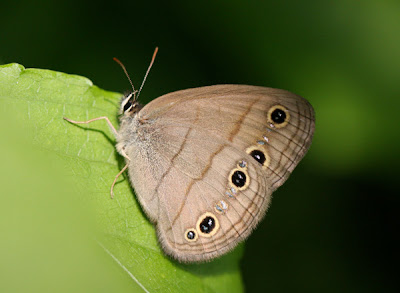
A final butterfly of late spring is the ubiquitous Little Wood-Satyr. These medium-sized brown butterflies are commonly found along wooded edges, fields, yards, and roadsides. The wood-satyr is not a skipper like the previous species and behaves differently. Little Wood-Satyrs often sit on a sunny perch and allow close observation. Wood-satyrs also fly much slower than skippers, making them easy to follow and observe. This species is currently very abundant in many habitats and can number in the hundreds over a small area in suitable habitat.

Sunday, May 8, 2011

Wilson's Warbler and more!

This morning, I got up to do some birding as I often do this time of year. I often get up early to listen for nocturnally-migrating birds to add a few extra species that I might not see later on. However, I was exhausted last night, so I woke up at 6am, fairly late by birders' standards. When I went outside, I immediately headed to the woods. Right away, I heard the common woodland species: Ovenbirds, Black-and-white Warblers, and Scarlet Tanagers. Once I reached the ridgetop meadow on the property, I started to hear other species. Several Rose-breasted Grosbeaks, Eastern Towhees, and Field Sparrows were singing along with the large flock of warblers that included Yellow-rumped, Blackburnian, Black-throated Blue, Black-throated Green, Prairie, Worm-eating, Nashville, Northern Parula, Common Yellowthroat, and American Redstart.

Once my neck was sore from watching all of the warblers, I headed back towards the house. Just up the hill from the house is a fenced in area that once held in goats. Now, the area is filled with young aspen trees. These trees must have been filled with insects, as there were loads of warblers here as well! Right away I heard both Yellow and Chestnut-sided Warblers singing from the patch of trees. The proximity of these birds allowed for a good comparison of these two similar-sounding species. Not long after, a Magnolia Warbler and several Yellow-rumped Warblers began singing.

As I was about to head to another area of the yard, I heard an unfamiliar song. As I continued to listen, I realized that I was listening to the song of a Wilson's Warbler. I had only seen this species in the yard once before, so this was an exciting find. The cooperative bird allowed me to record its song and photograph it before it flew away. Later in the day, I refound the bird in some fruit trees near the house. The final warbler of the morning was a Canada Warbler that was singing from a greenbriar thicket on the edge of the yard.


Today was an awesome day for birding in the yard -- I ended with 77 species including 19 warbler species!

Here is the audio and a photo of the Wilson's Warbler that showed up in the yard today:

Tuesday, May 3, 2011

Birds and Butterflies!

Finally, spring is fully here! Over the past few weeks, many species of birds have been arriving to the region. So far, much of the migration has been of warblers, with vireos, thrushes, and others to arrive soon.


Worm-eating Warblers are one of my favorite warbler species. Although the song of the WEWA is not nearly as melodic as many warbler species, it is exciting to hear it from the densest areas of forested hillsides where this species breeds. I found this individual who was singing and searching for food in an area where this species bred last year.

Northern Parula
Northern Parulas do not breed in the areas around my house, but they are common migrants in the spring and fall. This gorgeous bird stopped to feed in the apple tree next to the house.

Nashville Warbler
In the same tree as the parula above, this Nashville Warbler also stopped by to feed on the plentiful insects that visit the apple blossums. This species is never common in this area, but I have seen or heard several of them in the past few days. Note the red on top of the bird's head, a characteristic rarely seen in the field.

Wood Ducks
Warblers are not the only birds migrating! I spotted these, and several other, Wood Ducks flying overhead.


Eastern Comma
This Eastern Comma stopped for a sip of nectar on an ornamental cherry tree. This species, and the similar Question Mark, are common springtime butterflies of forests. Eastern Comma seems to prefer upland woodlands and the Question Mark inhabits creek and river edges.


I found this Eastern Pine Elfin on its foodplant, Pitch Pine. This species only appears for a short time in spring and is a treat to find. Pine elfins are most commonly found in upland barrens with pines.

Eastern Pine Elfin
One of two Eastern Pine Elfins I found this weekend.


Sunday, March 20, 2011

Bees and Springtails

During the past few days, the temperatures have reached into the 50s and even (for one day) into the 60s. With the rising temperatures, many of the early spring flowers are blooming: snowdrops, winter aconite, and crocuses. These flowers need pollinators, and over the past few days, I have seen the first bees of the year. This time of year, bees are not abundant like they are later in the year, but occasionally, one can be found curled up inside a flower or sunning on a blade of grass.

The first bee I found this year was this Lasioglossum sp. This guy was taking a rest on a Snowdrop (Galanthus) flower.

While the smaller bees are enjoying the small flowers of Snowdrops, some larger bees like this Cellophane Bee (Colletes sp.) prefer the larger flowers of the crocuses. This bee is covered in pollen from the various flowers it has visited.

This Cellophane Bee took a rest on a Snowdrop flower.


The third and final bee that I have found this year is this Cuckoo Bee (Nomada).


While the bees are enjoying the array of brightly colored flowers currently in bloom, springtails (Collembola) are enjoying the damp ground that comes with spring rains and melting snow. During a walk through the woods today, I encountered several types of these fascinating creatures.

Snow fleas (Hypogastrura nivicola) are, by far, the most common springtail during the winter. Groups of this and similar species congregate on top of the ice and snow making themselves visible. This time of year, they are harder to find as the snow has melted. However, as long as the ground stays damp, these guys will stay near the surface of the ground, often just under the leaf litter or under a fallen branch.

This small, blue springtail looks similar (in shape) to the Hypogastrura, but the abdomen is more cylindrical. This guy belongs to the group Entomobryomorpha, or elongate-bodied springtails (more specifically, Isotomidae). This group tends to be less gregarious than Poduridae and many species seem to prefer to "run" from danger than to jump.

This brightly-colored springtail (Dicyrtoma fusca) belongs to the order Symphypleona, the globular springtails. These springtails are very good jumpers and will hop out of sight if a potential predator gets too close. This individual was very cooperative and allowed me to get several decent photographs. Keep in mind that this "large" springtail is only a few millimeters in length.

Friday, February 18, 2011

Signs of Spring

This time of year, many people are searching for a sign that spring is near. In my yard, there are three easy ways to tell if spring is near: Turkey Vultures begin to fly, flowers begin to bloom, and American Woodcocks begin their territorial "singing". I witnessed all three of those today. First, the vultures. For most of the day, small groups of Turkey and Black Vultures sailed over the yard, rocking back and forth in the glorious sun. Second, the flowers. As the snow melted away, the flowers of Winter Aconite appeared. These bright yellow flowers (native to Europe) are always the first to bloom and brighten an otherwise dull landscape. And finally, the woodcocks. After the sun had set, my mom came to the door and mentioned that she may have heard a displaying woodcock. I grabbed my boots and headed outside to listen. Sure enough, a woodcock called--peent. Before long, several American Woodcocks were calling from the damp, muddy field.

Although the temperatures are supposed to dip again for the next few days, I hope that these signs are not just teasing us.

2010 -- Part I

I have been meaning to do this for a few weeks now, but I have been too busy. Now, with a break for Presidents' Day Weekend, I can finally compile a list of my favorite moments from 2010:

In February, a large snowstorm hit the region. In Kunkletown, we received around 18 inches of snow. Although fun, the large amount of snow made it difficult to get around. Revi, my dog, had no idea what to do with so much snow!


On February 17, country-singer Kathy Mattea visited Moravian College for a presentation about the impacts of coal mining on people, the environment, and music. Her presentation included songs from her album Coal. It was an incredibly powerful and inspiring presentation.


In March, I traveled to Costa Rica. The adventure began with a stop at middle elevations, where the group found this lovely Bay-headed Tanager. Although pouring rain, the birds were still around. In 2009 I visited Costa Rica and it was raining at this same spot. Unfortunately on that trip, the rain lasted for the entire week. In 2010, the returning trip members could only wish for drier weather than the year before.


From there, we went to El Zota, a biological station along the Caribbean coast. As always, this area was full of great birds as well as mud! Despite the mud, we received NO rain while in the lowlands, which was a lovely surprise.

After the lowlands, we headed to the mountains in search of the Resplendent Quetzal like the one above. We saw several which was a real treat. The birds were wonderful; the road to the birds was not.

As well as seeing quetzals, we saw numerous brilliantly-colored hummingbirds including this stunning Fiery-throated Hummingbird.


In May, many birds began returning to the yard including this Blue-winged Warbler that could be heard every morning from the house. Not long after the arrival of this bright warbler, other species began arriving including Prairie Warblers and the my first ever Mourning Warbler for the yard. The Mourning Warbler proved difficult to see, but sang all morning long and was the first thing I heard when I woke up for school.


During the second week of May, I began scouting for the World Series of Birding in New Jersey. I focused my scouting on southern New Jersey including places such as Heislerville WMA, Jake's Landing, Cape May, and Edwin B. Forsythe NWR (Brigantine). I was on the Subadult Skuaz with Luke Seitz and Ian Davies.

Brigantine was full of great birds including this White-faced Ibis. Other great birds were seen at Brig including Gull-billed Tern, White-rumped Sandpiper, and Black Skimmer. A Bar-tailed Godwit was seen at the Refuge, but apparently left before I was able to get there for scouting.


Finding Piping Plovers, like this one, is always a treat while birding Cape May County. I also found Northern Bobwhite, Dickcissel, and Common Eider in this bird-filled county while scouting.


With 188 species, the Subadult Skuaz were able to win the youth division! (We also were able to do some advertising for eBird thanks to Marshall Iliff.) We found many great birds with highlights of Golden-winged Warbler and Harlequin Duck, but missed common species like Northern Flicker, our most embarrassing miss. Overall, we had a great, fun day that we ended surrounded by a cacophony of Clapper Rails.


In June, I started and compiled the Monroe-Carbon Butterfly Count, which was part of the North American Butterfly Association butterfly counts. I surveyed the area around my yard and found, among many other species, this beautiful Striped Hairstreak on blooming Wild Hydrangea. The count was a success with several teams across the region including one at the Lehigh Gap Nature Center.


Sunday, February 13, 2011

February Birds

This weekend was the Lehigh Gap Area Feederwatch. This Sunday, I counted the birds that visited the feeders in the yard. I was able to find 17 species and 71 individual birds including American Tree Sparrows, Pine Siskins, and a Carolina Wren.

American Goldfinches, a Pine Siskin, and a House Finch at the feeder

As well as watching the birds at the feeder on Sunday, my mom and I traveled to Graver's Hill, a well-known spot for wintering grassland bird species. At Graver's Hill, we found several Horned Larks as well as a Snow Bunting. The bunting was sitting along the side of the road and allowed us to get fairly close.

One of the Horned Larks at Graver's Hill


Snow Buntings, like this one, are fairly common in Pennsylvania during the winter, but are always exciting to find. They often associate with flocks of Horned Larks.