Saturday, September 10, 2011

Fall Migration

After a few weeks of slow migration, the past two nights have been excellent for bird movement. Although I have not seen a tremendous number of birds in the mornings, I have certainly heard huge numbers of thrushes migrating overhead and seen masses of birds on the radar map. While out birding this morning, Scarlet Tanagers were the most numerous migrant. Over the course of the morning, I saw more tanagers than warblers, which is unusual for this time of year. Of the warblers I did see, Black-throated Blue Warblers are the only real "migrant" species, for Ovenbirds, Black-and-white Warblers, and American Redstarts frequently breed around my property.

 Even the male Scarlet Tanagers are plain this time of year. I managed to photograph this individual as it flew overhead.

While watching tanagers fly from tree to tree, I spotted a bird darting over the yard. As it flew, I recognized the bird as a cuckoo by the long tail and wing shape. The reddish color on the wings and the yellow on the bill identified it as a Yellow-billed Cuckoo. It is unusual to observe this species flying in the open, so I was extremely lucky to have the opportunity to watch and to photograph this bird!

 Yellow-billed Cuckoo in flight - note the reddish patches on the wings. This field mark distinguishes this species from the Black-billed Cuckoo.

 If the lighting is good, the yellow on the bill can be very obvious in flight.


Tonight is shaping up to be another great night for migration. A quick look at the NEXRAD map shows a lot of birds moving in the eastern United States, so if you can get out to do some birding tomorrow, there is a good chance there will be migrants around.


Finally, next weekend is Migration Fest at the Lehigh Gap Nature Center. The weekend will be filled with various programs about the annual migrations of our native wildlife, including bird research presentations, Monarch butterfly tagging demonstrations, a hawk identification workshop, and an evening presentation by Pete Dunne. For more information on this event, visit the Lehigh Gap Nature Center website.

Sunday, September 4, 2011

Meet Leonard

On Friday, butterfly enthusiast Billy Weber visited my property in search of a locally uncommon butterfly--the Northern Crescent. There are very few places this far south where this species can be found. However, there is a population in the field across from my house where I find them almost every year. Although the Northern Crescent is currently recognized as a separate species from the very common Pearl Crescent, the two are very similar and extreme caution is necessary when identifying these butterflies in the field.

Northern Crescent
note the large amount of orange on the forewings and hindwings

Pearl Crescent
the pattern is similar to the Northern Crescent, but the orange is more reduced in all four wings

While visiting the property, Billy did not find the crescents for which he came looking, but he did find another cool butterfly, a Leonard's Skipper. This butterfly is a robust, fast-flying skipper of late summer and early fall. This is the only butterfly in this region that has only one brood that comes out late in the season. In eastern Pennsylvania, the first Leonard's Skippers appear in August and continue through September. The phenology of this species is particularly interesting, as it emerges earlier in the northern latitudes to avoid the early frost.

Leonard's Skippers are not particularly rare, but are localized to large fields with their larval host plants. The caterpillars commonly feed on Little Bluestem (Schizachyrium scoparium), but will also feed on other grasses. Apparently Leonard's Skippers are especially attracted to pink and purple flowers, including Phlox and joe-pye-weed (Eutrochium). Unfortunately, meadow habitats with these requirements are declining in this region due to development. As with most species, once the habitat is destroyed, the population begins to fall. It is becoming harder and harder to find this species for this reason.

 Leonard's Skipper
the pattern on the underside of the wings is unique among skippers in this region

This afternoon, I went searching for a Leonard's Skipper in the field where Billy had one a few days before. After searching through large patches of blooming flowers, I finally found on nectaring on goldenrod (Solidago) flowers. This individual allowed me to take a few photos before it flew off into the center of the field.

 Leonard's Skipper

The Leonard's Skipper belongs the to genus Hesperia, a genus of skippers that are usually marked with a distinct chevron-shaped pattern of dots against a brown or orange background color. They all live in grassland habitats, and their caterpillars likely feed on the same or similar grass species. In Pennsylvania, we have three Hesperia species (in order of flight time): Cobweb Skipper (Hesperia metea), Indian Skipper (Hesperia sassacus), and Leonard's Skipper (Hesperia leonardus). Cobweb Skippers appear in early spring as the warm-season grasses are beginning to pop up from the ground. This species is declining rapidly across its range and is a real treat to find.


 Cobweb Skipper

Indian Skippers are the next to appear, usually around the end of May. This species will live in the same habitats as the Cobweb Skipper, but is more of a generalist, so it will inhabit a wider variety of habitats. Despite the wider habitat diversity, Indian Skipper populations are also declining. In late May, I have seen Cobweb and Indian Skippers flying together in a relatively undisturbed upland bluestem meadow.

 Indian Skipper

Wednesday, August 17, 2011

Birds in Flight (The Easy Ones)

As I have posted about before, the identification of birds in flight can be extremely difficult, for the birds are flying by quickly and often in poor light. These factors make this aspect of birding unappealing to many birders who then end up missing a lot of birds that fly over. Although I had been hawk watching before, I truly became interested in the identification of flying birds about a year ago as the fall migration season started. I was mainly interested in the non-raptors, as those had already been well-studied. Although the task seemed daunting at first, the more I looked at the birds, the easier it became to place a name to what I was seeing zip overhead. Take a look at the photos below to learn about some of the "easy" birds that are commonly seen flying overhead.

Any birder, and perhaps some non-birders, should be able to recognize this bird as a Canada Goose. See... you can identify birds in flight!


It may seem like a big transition from the last image, as this is an unclear image of a relatively plain bird. However, this is a common woodland species that can be identified by a number of clearly visible characteristics. First, when this bird was flying, I noted its relative size. It appeared to be larger than a warbler, but smaller than a robin. Second, most of the bird, including the underside and head, is a yellowish color. Finally, the tail and wings are dark, likely black. If you flip through any good field guide, you will see that the only bird that matches this description is the Scarlet Tanager.


Even a really good look at a flying bird can be misleading. This individual may seem unfamiliar at first, but if you look closely, it is one of our most recognizable bird species. The thick beak, pattern on the face, and crest (folded-down) identify this as a Blue Jay. This species also commonly vocalizes while flying.


Here we have a bird that seems to have relatively long wings and tail. The color of the underside looks orange, and the head appears darker. Often times, these characteristics are all that an observer needs to identify the very common American Robin. Robins also frequently vocalize while flying overhead, so it is useful to learn this various calls of this and other species.


Sometimes flying birds have a very distinctive characteristic that is not obvious when that species is seen sitting in a tree. For example, the large, white crescent marks on the wings of Rose-breasted Grosbeaks allow for quick, easy identification of this species in flight; however, this mark is rarely visible on a stationary bird. Grosbeaks are commonly seen flying over on September mornings after a good nocturnal migration, so keep an eye out for this species!


A final thing to look at in flying birds is whether they are in a flock or not. The songbird species mentioned above, like most migratory species, are relatively solitary birds. In this photo, it is clear that this small group of birds is traveling as a flock. This behavior significantly reduces the list of possible candidates. Next, note the fairly pointed wings that can be seen on the birds with wings outstretched. Together, these characteristics leave us with two species, Bobolink or Cedar Waxwing. Fortunately, birds in a flock often vocalize while flying overhead, and this flock was indeed vocalizing. The high-pitched trills identified these as Cedar Waxwings long before the flock was visible.

Saturday, August 13, 2011

A Gathering of Swallows

Each August, a large group of swallows gathers in the yard. This morning, I found one of these large groups flying around the yard. After a little while, the group settled, landing on the barn, power lines, and the house. The majority of the swallows were Barn Swallows, the most common swallow during this summer. About a week ago, the local population stood at about 22 individuals. This morning, I counted 52 individual Barn Swallows! The next common species was the Tree Swallow. This species also breeds on the property, but in much smaller numbers. During the past few weeks, I had seen about four Tree Swallows around the yard, but this morning there were close to 30!

A group of swallows from this morning

Although these two species are the common breeding swallow species, a few others showed up this morning. The first uncommon (for the yard) swallow was a Northern Rough-winged Swallow. This lone bird circled around and called its buzzy notes with some Tree Swallows before heading west along the ridge. Soon after, I heard a similar buzz, but this was from a Bank Swallow, an even rarer species! This small swallow sat alone on the line.

The tiny Bank Swallow preferred to sit away from the other swallows.

The third, and rarest species of the morning was the Cliff Swallow. While scanning through a group of Barn Swallows, I noticed one individual with a brighter forehead patch and a shorter tail. When the group took flight, I could easily see the tan rump, which immediately distinguished the Cliff from all of the other nearby swallows. As I searched the flock more carefully, I found three more Cliff Swallows! This is the highest count for this species in the yard!

Cliff Swallow

In flight, the tan rump patch of the Cliff Swallow is very visible and distinct.


Cliff Swallow (left) with two Barn Swallows

Sunday, July 31, 2011

Another Monroe County Butterfly Record

Red-banded Hairstreak by Corey Husic
Red-banded Hairstreak, a photo by Corey Husic on Flickr.

Earlier this summer, I found an Appalachian Azure near my yard in southern Monroe County. This egg-laying individual represented the first record of this species in the county. This past Saturday, while butterflying with Billy Weber near my house, I found another new butterfly for Monroe. As we were walking through the woods, we noticed a small hairstreak in the middle of the shaded path. The little butterfly took off, but eventually landed on a nearby fern. This butterfly turned out to be a Red-banded Hairstreak, which is normally thought of as a southern species. The only other Red-bandeds I have seen were in southern New Jersey. Farther down the path, we saw another one of these gorgeous butterflies. The larvae of this species are unusual because they eat rotting leaves rather than live, green leaves like the caterpillars of most butterflies.

The next two months are usually excellent for butterflying, as there is good diversity among the resident species, and occasional strays will wander in. Common southern wanderers include Little Yellows, Giant Swallowtail, and Fiery Skippers. Occasionally, butterflies such as the Common Ringlet will come down from the north.


Saturday, July 30, 2011

Katydids

Every year, around the last two weeks of July, the Common True Katydids begin singing here around my house in southern Monroe County. This loud, chattering species is quiet up until this point, then incessantly sings throughout the warm nights of late summer and early autumn. Often living in the canopy of deciduous forests, the Common True Katydid is very rarely seen, but is frequently heard singing katy-did, katy-didn't. Both sexes of this species sing, unlike many of the related katydid and cricket species. The Common True Katydid almost always starts singing after sunset, with only an occasional chatter during the daylight hours.


Common True Katydid (Pterophylla camellifolia)


The broad, rounded wings are unique among the local Tettigonids (members of the katydid family). This species is also one of the loudest due to its sound-producing wing mechanism, but this ability renders the Common True Katydid flightless, except for weak gliding abilities. Although this species is primarily found in the upper levels of the forest, it can occasionally be found in shrubs and small trees closer to the ground. The individual photographed above was sitting in a small birch tree about four feet off the ground, but was not singing.


While the Common True Katydid may be the loudest and the most well-known of the katydids, it is not the only species that inhabits our region. The Common True Katydid is our only "true katydid" (subfamily Pseudophyllinae), but there are several species of false katydids, meadow katydids, conehead katydids, and shield-backed katydids. Below are small accounts of a few of the other katydid groups with detailed information about a locally common species or two from each group.

The first major group of these false katydids is the round-headed katydids. This group is similar to the Common True Katydid because they tend to have broad, somewhat rounded wings, but the wings are still more pointed than the true katydids. I often find these species around eye-level at forest edges and hedgerows. Many of the round-headed katydids begin singing around the middle of July, often a week or two before the Common True Katydids begin their full chorus.

One very common round-headed katydid is the Rattler Round-winged Katydid. This species is commonly found sitting in shrubs at or below eye level singing its rattle-like song. This particular species seems to frequently sit in the open, so they are easy to find unlike many other katydids. This species usually sings only at night.


Rattler Round-winged Katydid (Amblycorypha rotundifolia)


The meadow katydids are another group of very common katydids this time of year. A meadow katydid is unusual for a katydid, for it looks more like a grasshopper than closely-related katydid species. Compared to the previously mentioned katydid groups, meadow katydids are small and more brightly-colored. Meadow katydids also tend to have more intricate songs. I usually start hearing the first meadow katydids, usually the Short-winged Meadow Katydids, around the beginning of August. Meadow katydids will sing during the day as well as into the night.

The Short-winged Meadow Katydid is a small, but common meadow katydid species. This species tends to sit right-side-up on grass blades, whereas other katydids tend to either sit upside-down or vertical on the blades of grass. The call of this species is a high-pitched buzz interrupted by small ticks. One song variation of this insect resembles that of the Grasshopper Sparrow


Short-winged Meadow Katydid (Conocephalus brevipennis)

The conehead katydids, which are very closely related to the meadow katydids, are common denizens of grassy and weedy areas. In eastern Pennsylvania, almost every weedy field seems to have a population of these abundant, yet secretive katydids. The coneheads begin singing just as the Common True Katydids start, which is usually around the end of July. Members of this genus can be heard during both the day and night, but they are excellent ventriloquists, making them difficult to find among grass blades and weeds. Coneheads sing most frequently at night, but are also commonly heard during the daylight hours.

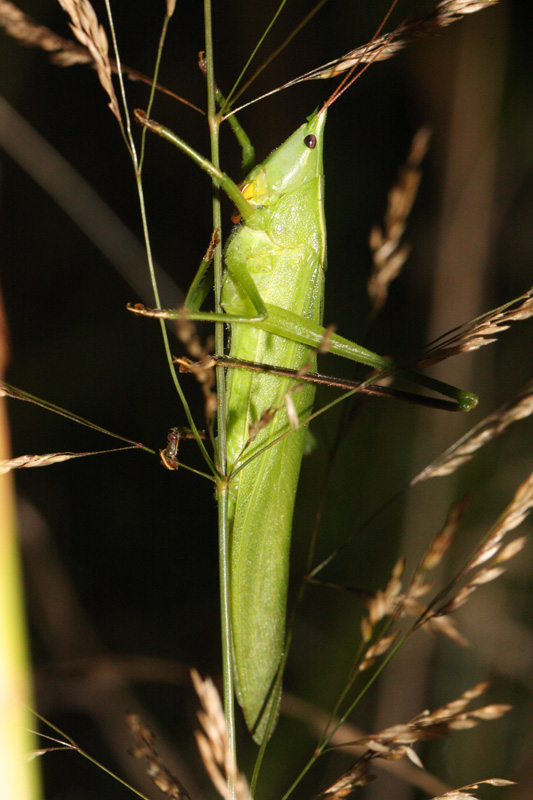
One of the most common species in eastern Pennsylvania is the Sword-bearing Conehead. This species is common in weedy fields where it often sits vertically on a blade of grass or the stem of a plant such as goldenrod. This species can be either green or brown.


Sword-bearing Conehead (Neoconocephalus ensiger) - green form


Sword-bearing Conehead (Neoconocephalus ensiger) - brown form

Another group of katydids that resemble grasshoppers are the shield-backed katydids. Shield-backs are named for the large plate that covers the thorax and part of the abdomen and wings. This group contains several native species, most of which are relatively uncommon and challenging to find. However, there is one non-native species that is extremely common and abundant in this area, the Roesel's Katydid (also spelled Rösel's Katydid). The Roesel's begin singing in late June, before many of the other katydid species. This species can be found singing its sustained buzz song in any field with tall grass, wildflowers, or small shrubs.


Roesel's Katydid (Metrioptera roeselii)

Although Common True Katydids are now starting to sing their loud, obvious song, and the Sword-bearing Coneheads can be easily heard in any field, my favorite katydids are the bush katydids in the genus Scudderia. The members of this group are all fairly skinny-winged, and sing weak songs. Members of this genus are difficult to discern from each other by appearance, but the songs are unique, making identification easier at night, when these katydids sing.

The Northern Bush Katydid is the species that is currently dominating the forest and forest edge understory chorus at night. The "song" of this species is a series of clicks followed by a series of tsits. I first heard this species singing during the first week of July. This species is often attracted to lights at night. I often find several sitting on the walls of the porch if the porch light is left on.


Northern Bush Katydid (Scudderia septentrionalis)

Another species of bush katydid that is common right now is the Curve-tailed Bush Katydid. This species prefers open fields over woods. Although extremely similar in appearance to the Northern Bush Katydid, the song of lisping sits rising in volume is distinct. I have seen these in the field near my house since early July, but they did not start singing until the middle of the month.


Curve-tailed Bush Katydid (Scudderia curvicauda)
For more information about these species and other singing wildlife, visit the Lehigh Gap Nature Center's Sound Field Guide.
Friday, July 22, 2011

Leafhoppers at the Porch Light

When people use lights to attract insects, they are often focused on moths. However, many other insects show up at these lights including beetles, flies, butterflies, stoneflies, and leafhoppers. Last night, while looking for moths (I'm up to 85 species for the month!), I also took a close at some of the the leafhoppers. Here are some of the more interesting ones that I found and photographed:


Japanese Leafhopper - Orientus ishidae


Alebra aurea


Tylozygus bifidus


Scaphoideus


Draeculacephala zeae