Saturday, March 24, 2012

An Early Spring

The past two weeks have been glorious, with sunshine and unseasonably warm temperatures every day. This extended period of warmth seems to have moved spring a little earlier. Even before spring officially started on March 20, birds were singing in the morning, short-distance migrant birds began showing up in the region, flowers of all sorts began blossoming, and even the earliest insects are out and about enjoying the early nectar sources.

Even a month ago, a small avian dawn chorus was present before the sun peaked over the horizon. Consisting of the cheery song of the Northern Cardinal and the repeated whistled notes of a Tufted Titmouse, the morning song was present, but hardly exciting. However, when I woke up this morning, I was treated to a wonderful selection of birds. The cardinals and titmice are still voicing their notes, but Field and Song Sparrows, an Eastern Towhee, and a small gathering of American Robins have joined in.


The Red Maples (Acer rubrum) are in full bloom in the woods, the flowers, either red, orange, or yellowish, fill the once gray, wintry woods. Although it is still March, and we are just entering in to spring, the butterflies are already taking advantage of this abundant nectar source. The classic early-spring butterfly, the Mourning Cloak gathers on the sunlit trees with the most flowers. These abundant harbingers of spring are often accompanied by other species. Over the past week, I have seen brightly colored Eastern Commas and even a brilliant blue Lucia Azure (Celastrina lucia, see here for more information on this genus) joining their somber-colored cousins.

While on a walk through the woods with my dog yesterday afternoon, I spotted a small patch of green that was away from any early-leafing non-native shrubs. The soft green color was the freshly emerged leaves on a Black-haw (Viburnum prunifolium), a native shrub that will be blooming and attracting butterflies in only a few months. Further down the trail, I spotted the yellow flowers of Spicebush (Lindera benzoin), an common early-blooming shrub of wet wood habitats. Spring has officially started, even though it maybe be a few weeks earlier than usual!

As a final note, if you are out enjoying the beautiful weather after dark, don't forget to look up and enjoy the two most visible planets in the nighttime sky, Venus and Jupiter:

Venus (top) and Jupiter (bottom) in the sky not long after sunset.

Sunday, February 26, 2012

Flowers in February


In eastern Pennsylvania, February is not usually considered a month when many flowers begin to bloom. However, the unseasonably warm temperatures over the last week and a half have caused many early-blooming species to emerge. Many of these species are flowers that will begin to flower as soon as there is an extended period of warm weather, so the bloom time varies greatly from year to year.

Snowdrops (Galanthus nivalis) - this species was blooming around this time last year as well. Warm weather usually causes the flowers to develop, although it takes several warm days for the flowers to actually open. Although the flowers are not yet open in the photograph, these flowers began to open on February 26.

Winter Aconite (Eranthis sp.) - With several days of sunlight, this flower is now in full bloom. This species began blooming last year around February 18, which is about the same time I first saw these flowers emerge in 2012.

Bird's-eye Speedwell (Veronica sp.) - This flower has actually been blooming through the entire winter. The flowers open in the sun, but close during nights and during colder days. This species grows very low to the ground and is easy to miss.

Primrose (Primula vulgaris) - This species is not quite ready to bloom, but a closed flower is visible amongst the basal leaves.

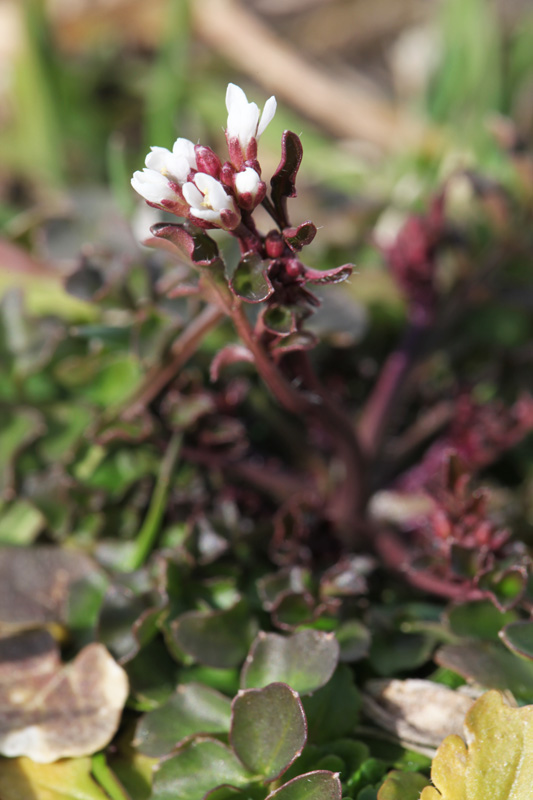
Bittercress (Cardamine sp.) - This flower could easy go unnoticed, as the small flowers grow very close to the ground in weedy areas. I found several hundred of these tiny plants blooming in my yard this week.

Crocus (Crocus sp.) - This is a very common early-blooming flower that can be found in a variety of colors, including yellow, orange, purple, pink, and white. Last year, crocuses did not start blooming in Kunkletown, PA until March 3. This year, the first flowers were seen on February 19.

Purple Dead-Nettle (Lamium purpureum) - This species is a common weed of gardens and lawns. This is the earliest I can remember seeing this species blooming. The flowers can sometimes be similar in color to the leaves, so if you find this plant, look carefully for flowers, as they may be hidden.


Skunk Cabbage (Symplocarpus foetidus) - Today (February 26) I found the first open flowers of this wetland plant in Kunkletown, Monroe County. The combination of red, yellow, and green on these unusual flowers make Skunk Cabbage and easy species to spot. (Photo from 2011)


Saturday, February 4, 2012

Identification Quiz!

I put together some "less than ideal" bird shots that make the identifications a bit tricky! If you think you know what the birds are, leave a comment and in a few days I will post the answers!

Pennsylvania - February

Pennsylvania - August

Pennsylvania - August

Saturday, January 14, 2012

Snowy Owl in New Jersey

Earlier today, my mom and I decided to head over to Merrill Creek Reservoir in New Jersey to see the Snowy Owl that has been there for the past few weeks. We weren't exactly sure how to get to the owl location, but we ran into a few other birders who had just gotten directions at the visitor center. Near the owl spot, we hiked up a trail along the side of the dam. About halfway to the top of the hill, one of the other birders spotted the owl across the rock pile on the "downstream" side of the dam. We had great views of this white owl as it sat still on a rock, moving only to preen itself or turn its head when it heard a noise.


This is only the second Snowy Owl I have ever seen. The first was near Route 209 in Brodheadsville, PA back in January 2003. This winter has been outstanding for Snowy Owls in the United States. Many birds have been reported across the country, including birds as far south as Oklahoma. It is thought that this sudden southward movement of this species is due to the population boom that occurred during the last breeding season. Young, inexperienced birds are often the individuals that wander out of the species's usual range, so with an increase of young birds, many more owls have moved south.

Using eBird, it is easy to see the southern invasion of this species compared to other years:

Winter 2011-2012 versus Winter 2010-2011

This is an incredible and beautiful northern bird that rarely shows up in this region. If you can, get out to see a Snowy Owl, as it may be a long time before another one shows up in your area!

Friday, December 30, 2011

Commentary on Winter Birding

If you asked birders when their favorite time of the year to go birding is, they will likely say spring or fall migration, or perhaps the summer season when most birds are in their finest form and singing beautiful warbling songs. Very few birders will answer with "winter." Nevertheless, winter is the time when one of the largest organized bird counts takes place--the Audubon Christmas Bird Count. Every year thousands of birders head to their local birding spots to scour the bushes and roadsides for winter birds. What draws all of these birders (especially those in the northern regions) out into the frigid temperatures? Perhaps it is the chance to meet up with other birders, an excuse to go birding in a normally "slow" season, or is it something else entirely?

Over the past several years, I have helped out with two Christmas counts in the area. For me, they each have a unique social aspect. The Lehigh Valley Christmas Bird County is a gathering of birder friends that I have known for many years. My mom has always helped with that count as well, so it is an opportunity to bird with her. At the end of that count, the Lehigh Valley Audubon Society hosts a count-off dinner where teams meet to share their checklists and experiences from the day while socializing and enjoying warm food in a heated building (all of which feel extremely nice after a day of winter birding). The second count I do is the Wild Creek-Little Gap count, which I have done with my dad for the past few years. Although it is only the two of us and not a big group, we always have fun searching for those elusive Horned Larks out in the frozen corn fields (we finally got one this year, but in a wheat field... guess we were looking in the wrong places) or counting ducks and geese gathered at a nearby lake.

In Pennsylvania, winter is a slow time for birding. After being outside several times today, I managed to find 23 species in the yard, but back in May I was able to find 77 species in a few hours in the same area! The scarcity of birds and unpleasant weather during the winter often keep birders indoors; they would rather watch the birds that come to the feeders than go out and search for birds like they would in the warmer months. The Christmas count manages to drag these birders outside; it gives them an reason for enduring the cold, wind, birdlessness, and frozen precipitation. Perhaps the knowledge that other people are out of their minds and are doing the same thing encourages the otherwise lazy birders to step out the door.

Birding may be slow, but maybe this is the factor that draws the birders to a Christmas Bird Count. Instead of finding warblers dripping off the trees, winter birding often requires a bit more searching through brush and walking through fields to get a reasonable percentage of the present bird species checked off the list. Personally, this added challenge is extremely exciting and helps me reassure myself that winter birding is a fun activity as I am putting on my wool socks at some horrid hour of the morning before an owling trek. Most normal people will probably never understand, but there is nothing like the rush that I feel when that emberizid finally responds to my distressed pishing or when I manage to discern the distant white speck as a raptor and not one of the local plastic bags.

Because birds can be so hard to find during the winter, when a rarity does show up on the Christmas Bird Count it is cause for celebration. Every year a few rarities show up for the count. A few years ago, during a major winter finch irruption winter, I found a big flock of Common Redpolls. Mixed in with the Commons, an uncommon species in its own right, was a single Hoary Redpoll, a rare visitor from the north that only shows up in the occasional winter season. Sometimes birds that are not even true rarities, but rather simply uncommonly encountered species, are exciting as well.

So why do birders go out and look for birds in the freezing weather? Maybe it's because of the social aspect. Birds of a feather do indeed flock together. Possibly it is a reason to go birding when birders would normally be enjoying the warmth of a heated building but are beginning to feel guilty about those few birds missing from their county year lists. Perhaps we go birding in the winter for that added excitement of finding an unusual species in a time when birds are generally scarce. Maybe it is a combination of all of the above.

Or maybe birders are just crazy.

Tuesday, December 27, 2011

Trail Camera

Trail cameras are small, motion-activated cameras that are primarily used for hunters looking for the best place to find a good deer population. These cameras are also useful for naturalists who are interested in learning about the wildlife that would normally be scared away by a human presence. Over the past year, I have set up a trail camera on my property in hopes of spotting wildlife that I don't often see. Here are a few of the animals I've captured on the camera:

Wild Turkey

White-tailed Deer at Jacobsburg State Park (for the 2011 BioBlitz)

White-tailed Deer

Red Fox

Thursday, December 1, 2011

Young and Future Generations Day

Today, December 1, was Young and Future Generations Day (YoFuGe Day) at COP17, which is a day to create awareness for the youth involvement in the fight against climate change. Throughout the day, youth were involved in several side events, high-level briefings, and actions that focused on the importance of youth constituencies at UNFCCC as well as youth participation in climate action around the globe. Below are a few examples of youth activities at the conference today.

As with every day at COP, the Youth Non-Governmental Organizations (YOUNGO) started off with a meeting to discuss the upcoming events, make decisions, and work on other youth-related activities.

Some of the youth at the morning YOUNGO meeting
The meeting consisted of a lot of discussions and decisions including the addition of three new working groups to the constituency: adaptation, biodiversity, and Rio+20. Adaptation refers to changes people will have to make if climate change does occur and causes alterations in the environment. In terms of climate change and related issues, biodiversity refers to how organisms and ecosystems will respond to ecological changes that occur as a result of climate change. Rio+20 is a meeting that will occur in June 2012 to mark the twenty year anniversary of the Earth Summit in Brazil. This summit developed three conventions, one of which is the UNFCCC. As a result of the major climate change aspect, YOUNGO will be working towards attending and becoming involved with the Rio+20 convention.

Biodiversity is important to solving climate change
Soon after the morning meeting, several young people "actions" took place. At a COP meeting, observer organizations can organize actions that often are designed to highlight a specific topic or idea. Often times, if an important decision is being made in the plenary sessions of the COP, concerned organizations will perform actions to show which side they are on and which decision they support. Other times, actions can simply be intended to reinforce an idea that is important for the organization or the conference as a whole. Many youth organizations (and YOUNGO as a whole) had actions today for YoFuGe Day. The World Association of Girl Guides and Girl Scouts performed the "cha-cha slide" to express support for taking "one step at a time" towards a maximum temperature increase of 1.5 degrees Celsius. YOUNGO also supported an action involving 1.5 degrees, where youth handed free neck ties to negotiators in an attempt to bring awareness to the 1.5 degree campaign. The ties, which state "I <3 1,5" (for you Americans, the comma is commonly used for the decimal separator in other countries), were a big success. Many negotiators were interested, including the delegates from small-island states that will be the nations most heavily affected by a temperature rise of over 1.5 degrees.

"I <3 1.5" Ties


YOUNGO member with a tie

Later in the day, the chairs of the Subsidiary Body for Implementation and the Subsidiary Body for Science and Technological Advice held a briefing specifically for youth. Each chair gave an overview of key issues being discussed and then opened the floor to questions about the current negotiations.

Right afterwards, the executive secretary of the UNFCCC held an "Intergenerational Inquiry," where youth and negotiators discussed the role of the youth constituency at the COP. Christiana Figueres, the UNFCCC Executive Secretary, spoke about the importance of youth becoming involved now, so that in the future, when the "hot potato," as she put it, is entirely in the hands of today's youth, it will not come as an unexpected and unfamiliar burden.

Christiana Figueres, Executive Secretary UNFCCC

 The next speaker was a teenage girl from South Africa. She shared a story of how she traveled to the city with her father when she was younger, and loved to see the farm animals along the way. It became her dream to one day show her own kids these animals and see the expressions on their faces when the witnessed the beauty of these creatures. Unfortunately, the stream that provided drinking water to these animals dried up as a result of anthropogenic environmental changes. Her dream was destroyed. She then turned to the negotiators and begged that they develop steps forward that do not crush the dreams and hopes of today's younger generation. This inspiring message finished the day of youth celebration with a feeling of hope for the youth, who are not only the leaders of tomorrow, but the leaders of today.

Reading a poem to start the Intergenerational Inquiry

The girl on the left gave a tremendous speech that moved everyone in the room

The use of social media to spread messages from the youth became extremely important at this year's COP. Within minutes, the video of the side event was online and shared with the world.