Monday, April 9, 2012

A Pond Draws in the Birds

We have a pond at the edge of our yard that is quite small and filled with various pond and wetland vegetation. A pond so small may seem like it would not attract many birds, but in fact, this pond has attracted numerous species that may not otherwise spend time on the property. The most common species to visit is the Mallard. During the spring, it is very common to find a pair or two swimming around. There has been a pair of Mallard in the pond every evening and morning for the past few weeks. For some reason, they disappear during the middle of the day!

Recently, Wood Ducks have been spending more and more time in the pond. Just last night, a pair spent a good portion of the evening swimming around and feeding in the pond. The brilliantly-colored male is a wonderful bird to watch, and the female, with her teardrop-shaped eye patch is equally intriguing.


Even herons have stopped by at the pond! I see Great Blue Herons at the water's edge a few times every year and once a Green Heron even stopped by for a little while. While the pond is too deep and not muddy enough for many shorebirds, Solitary Sandpipers don't mind ponds like this one. Occasionally one will spend the day at the pond before continuing on it's migration. I have only ever seen them at the pond during spring migration.


On rare occasions, even kingfishers will land in the trees over and near the pond. However, I've never seen one catch anything from the pond. There are no fish, but there are certainly plenty of Green Frog tadpoles.

This pond goes to show that even a small bit of water can really help birds as a stop over site when they are migrating! For some of these birds, a small, but beneficial habitat is far better than being without food or a habitat that they are used to.

Saturday, April 7, 2012

More Butterflies and a Pair of Racers

It was very windy here today, so most of the butterflies were perched in order to being blown away by the strong gusts. I couldn't find any more elfins today, but some of the other species were very cooperative!

Northern Spring Azures were out in force today, even more so than yesterday! This species is usually very skittish, but this male was clinging to its perch so that it didn't get blown away!


While the azures were numerous, the duskywings were not. I did manage to find this mating pair of Juvenal's Duskywings at the edge of the meadow not far from a single Sleepy Duskywing. When it comes time to lay her eggs, the female will oviposit (lay eggs) on an oak tree. Oaks are the preferred caterpillar host plant for several duskywing species. The Dreamy Duskywing, however, uses a variety of tree and shrub species and the Wild Indigo Duskywing uses wild indigo and crown-vetch.


While I was coming down the path headed back the the house, I spotted two snakes just off the trail. One of these black snakes was curled up and the other was completely stretched out to a length of four feet or more. When I got closer, I noticed that these were two Black Racers enjoying the afternoon sun. When I got too close, the curled-up racer shook its tail against the dry leaves making a sound similar to that of a rattlesnake. This species is similar in appearance to the Black Rat Snake, but the head shape and eye are different. A rat snake has a longer head and the eyes pop out a little giving a "bug-eyed" look compared to the racers.


Just a few weeks ago, I had seen another racer on the property. Unlike the ones from today, this guy was 15 feet up in a tree! This shows another characteristic to separate racers from rat snakes: the mostly black belly; rat snakes have white or speckled undersides.


Friday, April 6, 2012

An Elfin in the Woods

With the fairly warm temperature and plentiful sunshine today, butterflies were active despite the wind. This time of year, I find that woodland clearings are the most productive places to find butterflies, as these areas are often the sunniest spots around. However, some species, like Mourning Cloaks and Eastern Commas do not mind being in the middle of the woods. Other species like the duksywings often "patrol" clearings and paths by flying up and down the length of the opening chasing anything that enters the territory. To an overly sensitive Juvenal's Duskywing, these "threats" may include others of the same species, a larger Mourning Cloak, a leaf blowing in the wind, or even a person walking by! This behavior made this species especially difficult to photograph today. Whenever I went to take a photo, a Spring Azure would fly overhead and the duskywing would fly up and chase off the intruder.

Juvenal's Duskywing
Another species of duskywing that is flying right now is the Sleepy Duskywing. This species is a bit smaller than the Juvenal's, and is less aggressive. These two species (and all duskywings for that matter) use similar habitats and can often be found together. Today, I watched several Sleepy Duskywings chased down the trail by Juvenal's. In a few weeks, Dreamy and Wild Indigo Duskywings will become more common and the species flying now will disappear until next spring.

I also came across one of my favorite butterflies while I was out in the woods today. As I was watching a Spring Azure (the species flying now is likely Celastrina lucia), a small, brown butterfly darted past. At first I thought it was another duskywing, but I realized that it was flapping differently. When I got a better look, I saw orange markings on the top of the wings. When the butterfly finally stopped, I saw the intricate patterning of an Eastern Pine Elfin. This species only occurs in this area in April and early May, and can be hard to find due to its small size and somewhat picky habitat preference.
The Eastern Pine Elfin that I found today
Eastern Pine Elfins use a variety of host plants as caterpillars, all of which are in the genus Pinus, the pines. The individuals that I have seen in the past few years are likely using pitch pine, as this is the most common pine in the woods at this location. Last year, I even saw an elfin sitting on a very small pitch pine tree.

Eastern Pine Elfin on host plant, Pitch Pine (from 2011)

Friday, March 30, 2012

Answers to Identification Quiz

A few weeks ago I posted an identification quiz with some bad bird shots. If you did not already check out the quiz, you can see it here before reading the answers.

Here are the answers:

Pennsylvania - February
 
Upon looking at this photo, it is clear that there are several species present. Let's start with the grayish bird in the center-right, the only bird with a face visible in the shot. The fact that the bird is flying over water, has pointed wings, and a bill with that shape means that this is a gull. Small gulls, like Bonaparte's can be ruled out by the fact that the bird looks rather large and has a thick beak. Another possibility would be Ring-billed Gull. This bird appears to have a "thick build" a characteristic not usually associated with Ring-billed Gulls. The dark color and bill with a dark tip identify this bird as a young Herring Gull. Looking around the photo, we see other birds that are similar in size and structure to this Herring Gull. These too are Herring Gulls.

Next are the birds in the foreground that are flying low over the water. On the left there are two birds with a lot of white and on the left, two gray birds. All appear to have noticeable short tails and pointed wings. These characteristics nicely fit those of ducks. The birds on the left have white and black bodies and wings and orange/red feet. If you look on the lowest bird in the photograph, you can see the bird has dark coloration near the head. If you compare these field marks to ducks in a field guide, you will see that Common Merganser fits perfectly. The ducks over on the left are much darker and grayer than the male Common Mergansers. The wings are dark, with darker tips, and there appears to be a white patch on each wing. Considering these field marks and the association with the male Common Mergansers, these are female Common Mergansers.

What about the blurry birds floating in the water in the back? The shape and coloration of these birds match those of Common Mergansers, and that is exactly what they all are.


Pennsylvania - August
Here we have a small bird facing away from the camera. A few field marks are visible including dark wings with two strong wingbars and some yellow or orange near the face. Off all of the songbirds, strong double wing bars and yellow/orange head coloration are really only found on warblers. So now we've narrowed it down to one of about thirty species that regularly occurs in Pennsylvania. On top of that, the photo was taken in August, which suggests that this may be one of the dreaded "confusing fall warblers". Actually, this is NOT one of those tough IDs. The combination of dark wings with two very distinct white wing bars and yellow on the face narrows this bird down to Blackburnian Warbler with little trouble at all!


Pennsylvania - August
This bird may be the toughest one in the quiz. We can see a plain-looking bird, with dark brown or olive upperparts and yellowish underneath. We have no distinctive markings, and we can't see the face, a place where many birds have distinguishing markings. The lack of noticeable field marks (stripes, spots, patterns) brings several groups of birds to mind--kinglets, fall warblers, flycatchers, and vireos. We can also see the underside of the beak, which appears too wide for a warbler, too flat for a sparrow, and too long for a kinglet. This beak shape fits flycatchers and vireos. Of the small, yellow-green flycatchers that occur in this area, there are none with such yellow coloration and no wingbars or other markings on the wings. This leaves vireos. A few species can be quickly ruled out: White-eyed, Blue-headed, and Yellow-throated would show wing-bars and Red-eyed should have some distinct head markings that would be visible even though the branch is somewhat covering the face. This leaves two species, Warbling and Philadelphia.

These two dull vireos are well-known for being tricky to identify, especially in migration when both can occur together. Most Warbling Vireos start migrating and the beginning of August (they also breed in Pennsylvania), whereas Philadelphia Vireos start showing up around the end of the month. Since this photo was taken in August, and we don't know a specific date, migration timing is not a helpful identification tool. We also cannot see the facial markings which are often useful for separating these two. Warbling Vireos are generally whitish underneath and Philadelphia Vireos have more yellow. Since this bird is mostly yellow underneath, this must be a Philadelphia, right? Well, let's take another look. Notice how the yellow coloration on the chest appears the same as that on the throat. A Philadelphia Vireo usually shows a brighter yellow throat. Also take note of the white that is visible on the middle part of the underside--something that is uncommon on Philadelphia Vireos which would be solid yellow on a bright individual. From these distinctions, we can come to the conclusion that this is a Warbling Vireo. In the field, a view of the head and posture of this individual would aid the identification. As a final note, the coloration in this photo is very deceiving. Although the bird had more yellow that the "average" Warbling Vireo, the photo taken with sunlight shining through green leaves accentuated this characteristic. Always be careful when using colors to identify birds!


Quiz Responses:

Photo 1: Common Merganser and Herring Gull (100%)

Photo 2: Blackburnian Warbler (50%), Pine Warbler (16.7%), American Goldfinch (16.7%), Rusty Blackbird (16.7%)

Photo 3: Philadelphia Vireo (50%), Warbling Vireo (16.7%), Red-eyed Vireo (16.7%), Least Flycatcher (16.7%)

Congratulations to Ethan Kistler, who got them all correct.
Saturday, March 24, 2012

An Early Spring

The past two weeks have been glorious, with sunshine and unseasonably warm temperatures every day. This extended period of warmth seems to have moved spring a little earlier. Even before spring officially started on March 20, birds were singing in the morning, short-distance migrant birds began showing up in the region, flowers of all sorts began blossoming, and even the earliest insects are out and about enjoying the early nectar sources.

Even a month ago, a small avian dawn chorus was present before the sun peaked over the horizon. Consisting of the cheery song of the Northern Cardinal and the repeated whistled notes of a Tufted Titmouse, the morning song was present, but hardly exciting. However, when I woke up this morning, I was treated to a wonderful selection of birds. The cardinals and titmice are still voicing their notes, but Field and Song Sparrows, an Eastern Towhee, and a small gathering of American Robins have joined in.


The Red Maples (Acer rubrum) are in full bloom in the woods, the flowers, either red, orange, or yellowish, fill the once gray, wintry woods. Although it is still March, and we are just entering in to spring, the butterflies are already taking advantage of this abundant nectar source. The classic early-spring butterfly, the Mourning Cloak gathers on the sunlit trees with the most flowers. These abundant harbingers of spring are often accompanied by other species. Over the past week, I have seen brightly colored Eastern Commas and even a brilliant blue Lucia Azure (Celastrina lucia, see here for more information on this genus) joining their somber-colored cousins.

While on a walk through the woods with my dog yesterday afternoon, I spotted a small patch of green that was away from any early-leafing non-native shrubs. The soft green color was the freshly emerged leaves on a Black-haw (Viburnum prunifolium), a native shrub that will be blooming and attracting butterflies in only a few months. Further down the trail, I spotted the yellow flowers of Spicebush (Lindera benzoin), an common early-blooming shrub of wet wood habitats. Spring has officially started, even though it maybe be a few weeks earlier than usual!

As a final note, if you are out enjoying the beautiful weather after dark, don't forget to look up and enjoy the two most visible planets in the nighttime sky, Venus and Jupiter:

Venus (top) and Jupiter (bottom) in the sky not long after sunset.

Sunday, February 26, 2012

Flowers in February


In eastern Pennsylvania, February is not usually considered a month when many flowers begin to bloom. However, the unseasonably warm temperatures over the last week and a half have caused many early-blooming species to emerge. Many of these species are flowers that will begin to flower as soon as there is an extended period of warm weather, so the bloom time varies greatly from year to year.

Snowdrops (Galanthus nivalis) - this species was blooming around this time last year as well. Warm weather usually causes the flowers to develop, although it takes several warm days for the flowers to actually open. Although the flowers are not yet open in the photograph, these flowers began to open on February 26.

Winter Aconite (Eranthis sp.) - With several days of sunlight, this flower is now in full bloom. This species began blooming last year around February 18, which is about the same time I first saw these flowers emerge in 2012.

Bird's-eye Speedwell (Veronica sp.) - This flower has actually been blooming through the entire winter. The flowers open in the sun, but close during nights and during colder days. This species grows very low to the ground and is easy to miss.

Primrose (Primula vulgaris) - This species is not quite ready to bloom, but a closed flower is visible amongst the basal leaves.

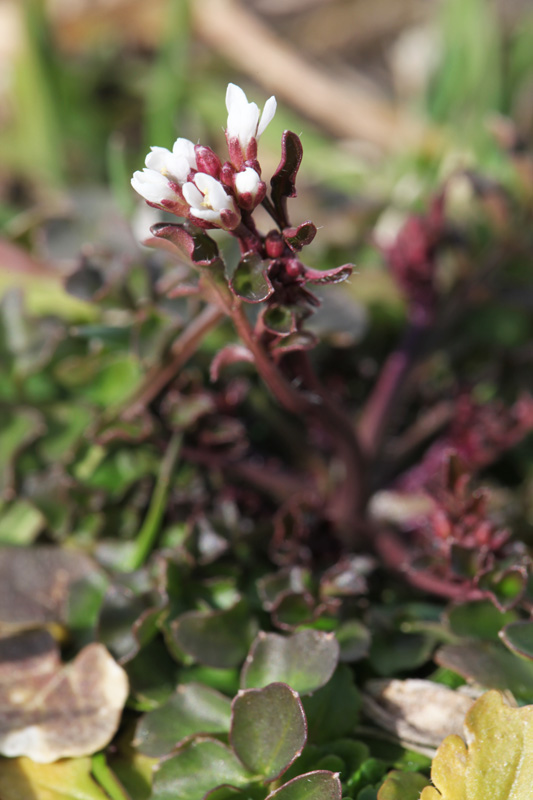
Bittercress (Cardamine sp.) - This flower could easy go unnoticed, as the small flowers grow very close to the ground in weedy areas. I found several hundred of these tiny plants blooming in my yard this week.

Crocus (Crocus sp.) - This is a very common early-blooming flower that can be found in a variety of colors, including yellow, orange, purple, pink, and white. Last year, crocuses did not start blooming in Kunkletown, PA until March 3. This year, the first flowers were seen on February 19.

Purple Dead-Nettle (Lamium purpureum) - This species is a common weed of gardens and lawns. This is the earliest I can remember seeing this species blooming. The flowers can sometimes be similar in color to the leaves, so if you find this plant, look carefully for flowers, as they may be hidden.


Skunk Cabbage (Symplocarpus foetidus) - Today (February 26) I found the first open flowers of this wetland plant in Kunkletown, Monroe County. The combination of red, yellow, and green on these unusual flowers make Skunk Cabbage and easy species to spot. (Photo from 2011)


Saturday, February 4, 2012

Identification Quiz!

I put together some "less than ideal" bird shots that make the identifications a bit tricky! If you think you know what the birds are, leave a comment and in a few days I will post the answers!

Pennsylvania - February

Pennsylvania - August

Pennsylvania - August