Wednesday, October 31, 2012

#153

Every year I keep track of the number of species that I find in my yard. Last year was an excellent year--I broke my previous yard year record by finding 150 species from January to December. However, this year has been even better. On September 30, a flock of Pine Siskins in the yard brought my 2012 list to 150 species, tying last year's result. Since then, siskins have become very abundant in the yard.
 
Pine Siskin on goldenrod
During the big sit on October 13, I found two more species (that I will post about in a full report of the day soon!) for the year list. Although I had now seen 152 species in the yard during 2012, I was missing a few fairly common species. One such bird was the White-crowned Sparrow, a generally uncommon bird in the area, but one that I occasionally see in the fall. While out birding on the morning of the 21st, I finally found a White-crown, an immature that was feeding in a large patch of goldenrod with variety of other sparrows. The bird then flew into a nearby tree before disappearing back into the weedy field.

immature White-crowned Sparrow - yard year bird #153
As I mentioned, the White-crowned Sparrow was certainly not the only sparrow in the field. In fact, the entire meadow was filled with lots of sparrows. The most abundant species was the White-throated Sparrow. These large relatives of the White-crowned could be found in almost every goldenrod patch of brushy edge this morning. Singing and chipping, this species is hard to miss.

Song Sparrows were next in terms of abundance. This is a species that, for some reason, disappeared over the summer here in Kunkletown, but has since returned in full force. While not nearly as noisy as the White-throats, Song Sparrows will sing and call this time of year. Learning the various call notes of sparrows can be particularly helpful when searching through a flock of sparrows that is rapidly moving through dense goldenrod or a brushy edge.

Somewhat surprisingly, Swamp Sparrows were very common that morning. These drab birds are quite common in the field, but I rarely see more than one or two at a time. On this morning, at least six of these guys were sitting along the field's eastern edge, hiding among the tangles of low shrubs and vines. Swamp Sparrows can be very hard to photograph, as they stay deep in the brush, but one individual popped out for a moment.


As I mentioned in my last post, Lincoln's Sparrows are migrating through the region this time of year. Although the peak for this species was a few weeks past, there were still some around including one that I discovered along the brushy edge of the field, not far from where the Swamp Sparrow was photographed. I often find these two closely-related species together in brushy and weedy habitats.


As the Lincoln's Sparrows reach the end of their migration through Pennsylvania, other species are just starting to arrive. One such species is the Fox Sparrow, a bird that is most common in the state during the months of November and March. However, they begin to show up in brushy areas in the end of October. I saw two, the first ones of the season, in the yard on this sparrow-filled day. Their bright reddish coloration really stood out in the tangle of green and brown leafless vines.


Warblers have moved on, and sparrows have arrived. By some accounts, we are entering into a season of dull birding. However, the truth is quite the opposite. The month of November is an excellent time of year to find rarities! The shorter days and chilly temperatures don't necessarily mean fewer exciting birds!


Monday, October 8, 2012

A Pretty Sparrow

Lincoln's Sparrows are secretive birds. When they migrate through Pennsylvania in the spring and fall, they stick to the cover of dense brush and weedy fields. As a result, it is often very tricky to get a good look or photograph of this species. However, I came across a very cooperative Lincoln's Sparrow this morning that sat in the open for several minutes. What an opportunity to observe this beautiful sparrow!


Saturday, September 29, 2012

Fall Warbler Quiz

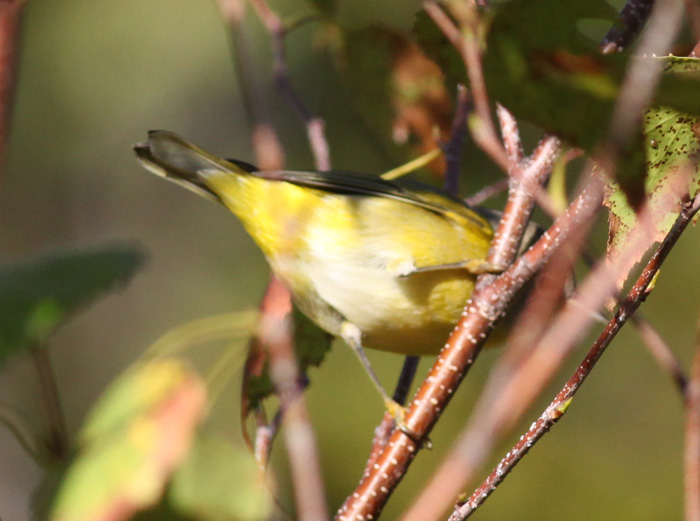
Over thirty species of warblers migrate through Pennsylvania during the fall. While some species, like Northern Parula and Black-throated Green Warblers are easily recognized, some can be tricky to identify. Try this quiz to test your ability at identifying these "confusing fall warblers." I will post the correct answers and identification remarks in a later post.

Photo 1:


Photo 2:

Photo 3:
 

Photo 4:

Photo 5:

Sunday, September 2, 2012

Goldenrod Surprises

Goldenrod flowers host an amazing diversity of insects and other creatures, many of which hold surprises that require a closer look:

Goldenrod Soldier Beetles (Chauliognathus pensylvanicus) are one of the most abundant insects on goldenrod. Thousands of these orange and black beetles can be found in a large patch of these flowers. While walking around the field today, I saw a beetle with wings open, perhaps getting ready to take off. But that was not the case. This soldier beetle fell victim to a fungus, Eryniopsis lampyridarum. In an infected area, hundreds of these beetles can be found hanging lifeless underneath the flowers.


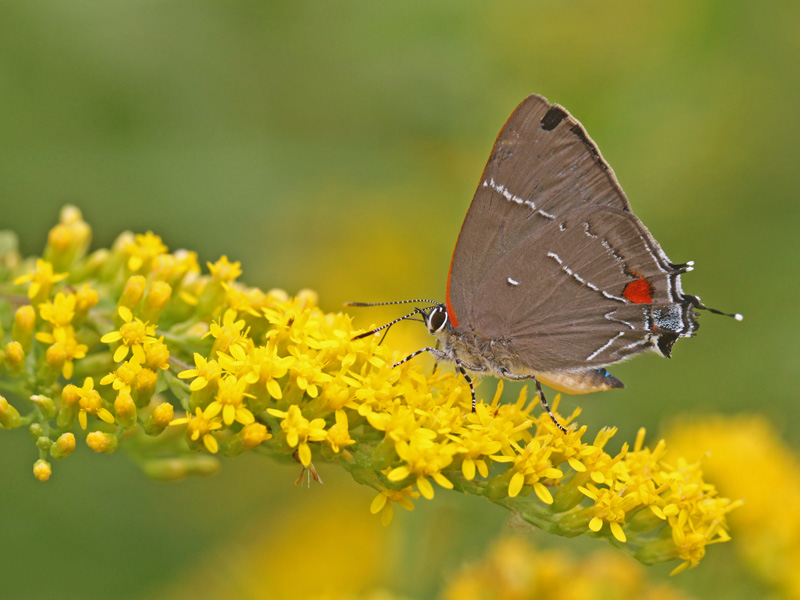
With August behind us, the season of butterflies is slowly slipping away. Swallowtails become scarce, and skippers, once filling every flower in the field, have all but disappeared for the year. However, a keen observer may be able to find late-season fliers enjoying the goldenrod and asters. One might find Variegated Fritillaries, Common Buckeyes, Gray Hairstreaks, or maybe a White M Hairstreak, like the one I encountered today.


The white "m" shape and lip-stick red spot on the hindwing are unlike any other species. But the red marking, soft brown background color, and powdery blue hindwing spot are not what make this butterfly incredible.


When the White M Hairstreak takes off, this brown insect transforms into an ephemeral flutter of shimmering cobalt.


Like the soldier beetle, many insects that associate with goldenrod match the color of the flowers. This White-banded Crab Spider (Misumenoides formosipes) sat camouflaged waiting for prey, in this case, an unsuspecting Eastern Yellowjacket (Vespula maculifrons), to land within striking distance.


The leaves are starting to fall from the trees. Birds have started to migrate south for the winter. Although the colder months are fast-approaching, there are still plenty of insects enjoying the variety of late-blooming flowers. Don't forget to take a closer look at the next flower you pass, you may find something extraordinary.

Sunday, August 26, 2012

Invasion of the Ladies

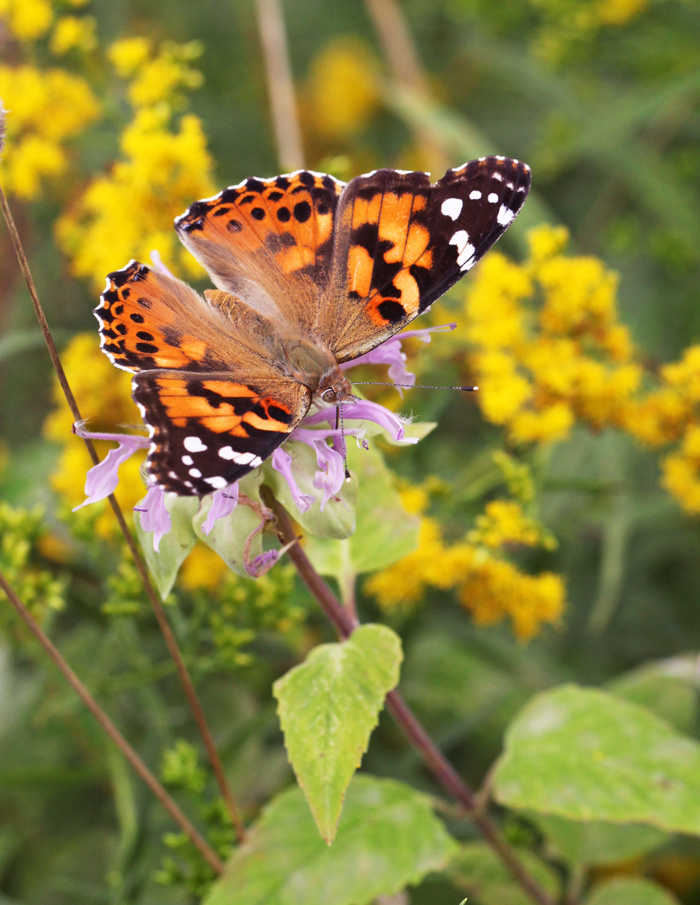
The Painted Lady (Vanessa cardui) is the most widespread butterfly in the world. Due to its strong migratory tendencies and use of a massive variety of host plants, this species can be found throughout North America, Europe, and Asia. Although the Painted Lady is incredibly widespread, it is not particularly abundant in many locations. For example, I usually see fewer than three in a year here in eastern Pennsylvania. In fact, many years I never see a Painted Lady.

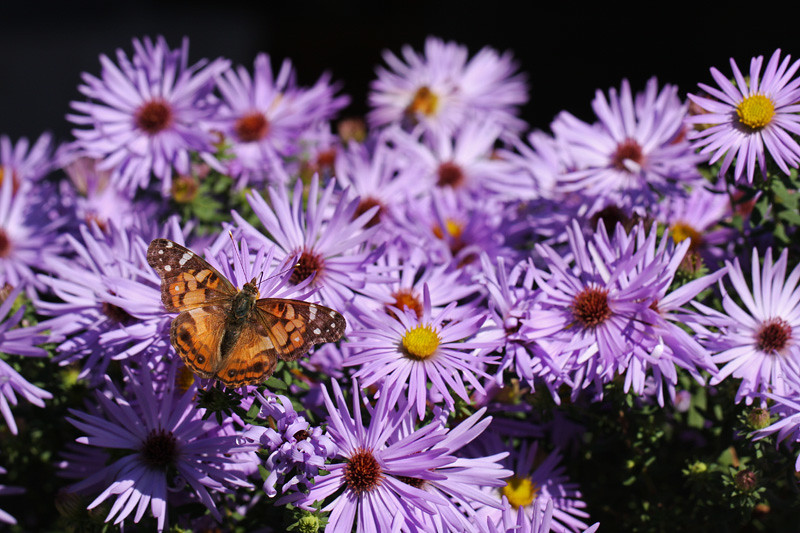
This year seems to be different. Earlier this summer, I found a single Painted Lady nectaring on blooming Common Milkweed in the yard. This was only the second individual of this pink and black butterfly that I had noted for the property! After a few days of fueling from the milkweed patch, the lady moved on. As the summer progressed, I saw numerous American Ladies (Vanessa virginiensis), the more common and more orange counterpart of cardui.

American Lady, the more common Vanessa in this region

When I stepped out of the house yesterday morning, a brightly-colored butterfly shot up from a pink Phlox next to the porch. The butterfly fluttered skyward with quick wingbeats in a corkscrew-like flight pattern, characteristic of the ladies. This individual went out of sight, but I soon noticed several other ladies on nearby flowers.

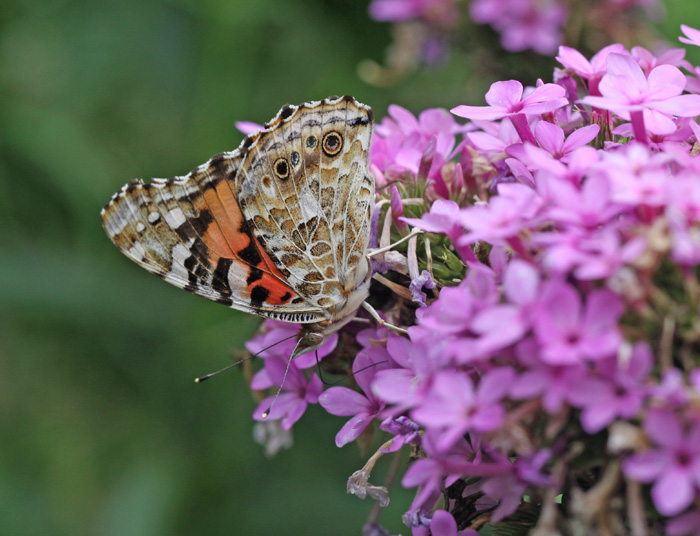
Painted Lady on Phlox

I immediately noticed the pink-orange color that seemed slightly different than the coloration of an American Lady. When I got closer, I noticed the smaller details in patterns that separated these individuals from their similar cousins. As I looked around, I counted about a half-dozen of these gorgeous insects, more Painted Ladies than I had ever seen at one time (except, perhaps, for when we raised them from caterpillars in kindergarten). Several more scatted off the gravel driveway as I walked past. Almost every open flower in the field was attended by one of these butterflies--the ladies were everywhere!


As the sun got stronger, I spotted a single Monarch gliding southward on a gentle breeze. One of the ladies from the flowers in front of me flew towards the Monarch, hitching a ride on the same wind as the larger migrant. Out-flapping the Monarch, the lady took the lead and disappeared into the distance.

Monarch on its way to Mexico

August and September are the primary months for butterfly migration here in Pennsylvania. Southbound species, including Monarchs, ladies, and Red Admirals, all begin their journeys around this time. The ladies and admirals may only travel far enough south to reach year-round warm weather, whereas the mighty Monarch will travel all the way to central Mexico. Early autumn is also the season when many southern species wander north. Giant Swallowtails and Long-tailed Skippers start to show up in Pennsylvania around the middle of August every year. Other species including Ocola Skippers, Little Yellows, Sleepy Oranges, and Dainty Sulphurs seem to have "boom" years, when large numbers suddenly begin to appear far north of their typical southern ranges. This year has been the year of the Dainty Sulphur, with droves of these petite southerners popping up throughout Ohio and Pennsylvania.

Today, I found about fifty of these beautiful ladies in my yard. I know they are transients this time of year, but I hope they at least stick around for a few more days!


Monday, August 20, 2012

Sunday, August 19, 2012

Goatsuckers.

Every spring, birders gather around old fields and meadows to listen to the pzeent! of the American Woodcock. This display marks the beginning of spring--the ground has thawed and birds are ready to breed. Some nature groups even lead walks specifically for listening to the spring display of the woodcock. However, many of this birders do not give notice that there is a bird that goes "pzeent" in the fall, long after the springtime woodcocks have become silent. These are the calls of the goatsuckers. The nighthawks.

While nighthawks are not actually hawks (and no, they don't actually suck milk from goats as myths have portrayed), they do resemble buoyant falcons--bouncing through the humid air on pointed wings. Flocks gather over buggy fields as soon as the goldenrod begins to bloom in August, catching insects on the wing.

Just the other day I saw my first flock of fall. One short of a dozen, the group had convened over a nearby field, soaring and diving to catch the bounty of midges high above the ground. Competing with swallows and darners, the nighthawks spent almost twenty minutes feasting before moving down the ridge.


Nighthawks, some of the most impressive aerialists of the bird world, often go unnoticed as they zip over meadows, parking lots, and almost anywhere with insects that lies along their southbound route. Unnoticed, yes. But woodcocks would be too if we made no effort to search. While woodcocks are harbingers of spring for some, nighthawks fill this role for me in the fall. The warm, muggy nights are coming to an end, soon to be replaced with more pleasant days filled with sun and cool breezes. Plus, I find watching swooping and diving acrobats to be far more exciting than listening into the darkness for a call from a sneaky sandpiper sitting still in some soggy sedges.


I'm not saying that those goofy, disproportionate timberdoodles aren't fun... just don't forget to take a moment to listen to what else goes "pzeent" in the night.