Saturday, April 24, 2010

'M' is for butterfly...

Every morning, I wake up to the wonderful sound of the birds singing outside my bedroom window. These days, the chorus consists of the warble of the Purple Finch, the fast, cheery song of the Ruby-crowned Kinglet, the nasal "inking" of a Red-breasted Nuthatch, and the harsh notes of a Brown Thrasher. Occasionally, I hear the White-throated Sparrow lamenting for Sam Peabody, but as the migration picks up, I hear fewer and fewer of these winter visitors. This morning I only found two in the yard, but warblers took the place of the missing sparrows.

In the woods this morning, I heard several Yellow-rumped, Pine, and Black-and-white Warblers. Once the sun warmed up the air, a few Blue-headed Vireos started singing. Although the focus of the migration is often on these colorful birds, many other birds have been moving. Quite frequently, I have seen Double-crested Cormorants, a bird usually associated with water, fly over the house. Also, twice in the past week, I have seen Wood Ducks fly over the yard.

With the temperatures in the upper sixties, more butterflies have emerged than the early-spring fliers, which include the Spring Azure and the Mourning Cloak. Two weeks ago, a walk through the woods would produce 4 species at the most, but now, I can find eight or more in a small area. Swallowtails have emerged during this past week, and are common throughout the woods. Eastern Tiger Swallowtails are fairly common, but the Spicebush Swallowtails seem to be ubiquitous this spring. Spreadwing Skippers, specifically Juvenal's and Sleepy Duskywings have also been flying. Here in Kunkletown, these two species seem to enjoy nectaring on the lowbush blueberry (Vaccinium pallidum) which is blooming on the ridge top.

The most exciting butterfly was one that I almost ignored. I saw a small butterfly fluttering along the ground, and assumed it was another Spring Azure. It landed in front of me, and took off when I got too close. When it flew, I noticed that the top of the wings were not the pale blue of an azure, but rather a deep, iridescent blue. When I bend down to get a better view, I realized that the little lepidoptera was a White M Hairstreak. This small butterfly is brown underneath, with a white "m" on the hindwing. There is also a small blue and an orange spot. The top is a dazzling blue color.

White M Hairstreak

As a final note, a few "summer-like" animals have joined the yard. Just recently, the Gray Treefrogs started singing as well as the Pickerel Frogs and the Spring Field Crickets.

Saturday, April 3, 2010

Costa Rica, Day 3

Day 3: March 8, 2010

We woke up early, around 4 am, and headed along the road to a large lagoon. Along the way, we heard several Common Pauraques, a Central American Pygmy Owl, and a single Spectacled Owl. When the sun rose, we were in the forest. We listened and watched as the birds woke up and started singing. While in the woods, we heard the distinctive call of a Green Ibis. Through the trees, we were able to see a pair of them flying above the lagoon. After seeing those, we found a White-necked Puffbird in a tree above our heads.

As we continued down the path, we heard the mournful notes of a Slaty-breasted Tinamou followed by calls of both Great and Little Tinamous. When we reached the lagoon, we immediately saw several Cattle Egrets in a tree over the water. With them, was an Amazon Kingfisher, which caught a fish upon our arrival. The water itself had very few birds, but a lone Pied-billed Grebe was a treat.

Passionflower (Passiflora vitifolia)

Although the water was fairly empty, the trees around were not. Along the water's edge, I spotted a Scaled Pigeon atop a small tree. The beautful pigeon sat in the open for several minutes before flying away. Hummingbirds zipped back and forth across the trail, primarily Rufous-tailed, but there was one Blue-chested Hummingbird which briefly sat on a flower. Most of the group headed into the woods a bit to find White-collared Manakins which could be heard from the trail. I decided to stay on the trail, hoping I could find more birds, and I am happy that I did. The trees were filled with interesting birds, including Common Tody-Flycatcher, Plain Xenops, Broad-billed Motmot, and some warblers.

Scaled Pigeon

When the group emerged from the woods, we heard a distant, but recognizable squawk--that of a Great Green Macaw. We rushed to a clearing, were we saw three of the gigantic birds fly over the trees. After the macaws, we headed back along the road, stopping a few times for Shining Honeycreepers, Squirrel Cuckoo, Blue Dacnis, and Bay Wren. Not long before reaching El Zota headquarters, my mom and I saw a large black mammal run across the road. The animal was a Tayra, an arboreal otter.

male Blue Dacnis


Squirrel Cuckoo

When we returned to the buildings at El Zota, I noticed a kettle of raptors forming overhead. The kettle consisted of about 20 Broad-winged Hawks and an Osprey. My mom and I watched as the birds streamed out and headed north. A few minutes later, while watching a male White-necked Jacobin flitting around at the top of a tree, I noticed another kettle. This one was much larger than the previous, but again, consisted mainly of Broad-wings. A few of the other guys got on the kettle, and we were able to pull out nine Swainson's Hawks and a Zone-tailed Hawk among the 80 or so Broad-wings.

Osprey and Broad-winged Hawk


Cinnamon Woodpecker at its nest

After lunch, my mom and I decided to walk along a road out of El Zota, the same one I had walked the previous afternoon. In the same spot as the day before, we found two Black-capped Pygmy-Tyrants, which were new for my mom. Along a small lagoon, we scared up an Anhinga and a Green Basilisk lizard from the shore.

Black-capped Pygmy-Tyrant


male Uracis fastigiata

After the short walk, a few of the other birders set up mist nets along one of the trails. While setting up the nets, we noticed a male Black-throated Trogon sitting a few meters above us, so we called that species first. The bird responded immediately by flying down towards the net. Unfortunately, he did not go into the net. For a few minutes, the trogon flew around, at eye-level, providing incredible views of the brightly-colored bird. After a while, we gave up and tried other species, all of which got responses from birds, but unfortunately no birds flew into the net. During the mist-netting attempt, we heard/saw some neat birds, including Plain-brown Woodcreeper, Chestnut-backed Antbird, and Orange-billed Sparrow. We also watched several baby Spider Monkeys while waiting for tapes to call in the birds.

male Black-throated Trogon

After the failed atempt to catch birds, we walked along Sendero Swampo and did a bit more birding, but did not find anything incredibly exciting.

Sendero Swampo (translated: Swamp Trail) lives up to its name

After the hike, it was getting dark, so we set up a series of bat nets, much like the nets we used early to try and capture birds. During dinner, someone periodically checked them, to make sure no bats were left unattended. After dinner, no bats had been caught, but Dr. Whidden, a bat expert, set up a bat detector to get an idea of how many bats were flying around.

While checking the bat nets, we found
this
Gonatodes albigularis (Yellow-headed Gecko)
...

...and several Hypsiboas rufitela (Scarlet-webbed Treefrog)

We watched in amazement at the number of bat calls appearing on the screen, which showed the density of bats in the area. A little while later, while checking the bat nets, we noticed two small bats were caught. Dr. Whidden carefully removed them and brought them to a lit room for identification. This was a challenge, but we were able to determine that one was a fruit-eating bat, and the other a nectar-feeding bat.

Nectar-feeding bat (I'm not sure of the species)

Before I went to bed, I heard three Crested Owls calling from the forest.


March 8, 2010 list:

Great Tinamou
Little Tinamou
Slaty-breasted Tinamou
Pied-billed Grebe
Anhinga
Cattle Egret
Green Heron
Green Ibis
Black Vulture
Turkey Vulture
Osprey
Broad-winged Hawk
Swainson's Hawk
Zone-tailed Hawk
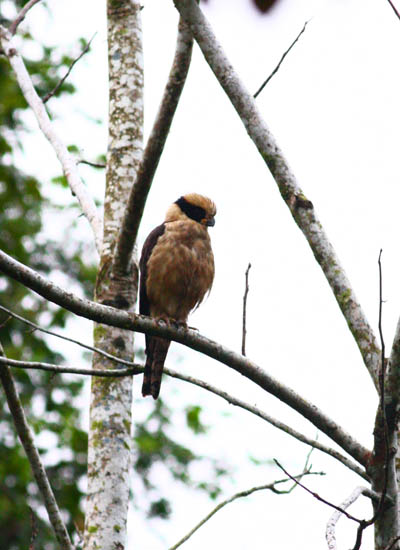
Laughing Falcon
White-throated Crake
Purple Gallinule
Northern Jacana
Pale-vented Pigeon
Scaled Pigeon
Red-billed Pigeon
Olive-throated Parakeet
Great Green Macaw
Orange-chinned Parakeet
Red-lored Parrot
Mealy Parrot
Squirrel Cuckoo
Groove-billed Ani
Crested Owl
Spectacled Owl
Central American Pygmy-Owl
Common Pauraque
Gray-rumped Swift
Lesser Swallow-tailed Swift
Bronzy Hermit
Long-billed Hermit
White-necked Jacobin
Blue-chested Hummingbird
Rufous-tailed Hummingbird
Violaceous Trogon
Black-throated Trogon
Slaty-tailed Trogon
Rufous Motmot
Broad-billed Motmot
Ringed Kingfisher
Amazon Kingfisher
White-necked Puffbird
Collared Aracari
Keel-billed Toucan
Chestnut-mandibled Toucan
Black-cheeked Woodpecker
Cinnamon Woodpecker
Chestnut-colored Woodpecker
Pale-billed Woodpecker
Plain Xenops
Plain-brown Woodcreeper
Wedge-billed Woodcreeper
Northern Barred-Woodcreeper
Cocoa Woodcreeper
Streak-headed Woodcreeper
Barred Antshrike
Chestnut-backed Antbird
Yellow-bellied Elaenia
Black-capped Pygmy-Tyrant
Common Tody-Flycatcher
Bright-rumped Attila
Rufous Mourner
Great Crested Flycatcher
Great Kiskadee
Boat-billed Flycatcher
Social Flycatcher
Tropical Kingbird
Rufous Piha
Cinnamon Becard
Masked Tityra
Black-crowned Tityra
White-collared Manakin
Lesser Greenlet
Purple Martin
Gray-breasted Martin
Band-backed Wren
Bay Wren
Stripe-breasted Wren
Plain Wren
House Wren
White-breasted Wood-Wren
Tropical Gnatcatcher
Wood Thrush
Clay-colored Thrush
Tennessee Warbler
Chestnut-sided Warbler
Olive-crowned Yellowthroat
Buff-rumped Warbler
Bananaquit
Passerini's Tanager
Blue-gray Tanager
Palm Tanager
Golden-hooded Tanager
Blue Dacnis
Green Honeycreeper
Shining Honeycreeper
Variable Seedeater
Thick-billed Seed-Finch
Orange-billed Sparrow
Black-striped Sparrow
Black-headed Saltator
Black-faced Grosbeak
Baltimore Oriole
Scarlet-rumped Cacique
Montezuma Oropendola
Olive-backed Euphonia

Jaguar track

Tayra
Spider Monkey
White-faced Capuchin
Howler Monkey
Varigated Squirrel

Agouti track

Green Basilisk
Strawberry Poison Dart Frog
Black-and-Green Poison Dart Frog
"Brown" Spectacled Caimam
Saturday, March 27, 2010

Costa Rica, Day 2

Sorry it took so long for this next installment; I've had a busy week.

Day 2: March 7, 2010

At around 4:30 in the morning, the Howler Monkeys started howling away, just a bit into the woods from where we were sleeping. This early alarm clock was, as I suggested, a bit early. However, waking up early allowed me to hear a singing Common Pauraque, possibly one of the ones we saw driving in the night before. I sat and listened for a while, but did not hear much else until around 5:30.

When it was light enough to do some birding, I headed outside and decided to stay right around the cabin. Before long, birds were everywhere. Green Herons, Northern Jacanas, and several Purple Gallinules were along the edge of the lagoon, while a Ringed Kingfisher sat on a dead branch over them. From near the creek came calls of Broad-billed and Rufous Motmots, as well as the song of the Buff-rumped Warbler.

Birds flooded into the trees nearby. Some of the species in the trees included Band-backed Wren, Black-and-white Warbler, Black-faced Grosbeak, and Tropical Gnatcatcher. When the numerous birds in the trees in front of me left, a few of the other birders joined me. Before too long, we heard and saw a Pied Puffbird, which was sitting at the top of a nearby snag.

Pied Puffbird

After breakfast, the crew headed along the main road which goes through El Zota property. As the sun warmed the earth, many more birds became active. In a clearing, we found lots of Collared Aracaris, a beautiful pair of Slaty-tailed Trogons, a cooperative Brown-hooded Parrot, and lots of Pale-vented Pigeons which we affectionately call PVPs.

Male Slaty-tailed Trogon


Collared Aracari

In the woods near the clearing, we watched several Spider Monkeys and a White-faced Capuchin travel through the trees.

We then headed farther up the road to a large, scrubby clearing. Here, we heard a Little and Great Tinamou singing in the woods. A few Snowy Cotingas flew over while White-collared Manakins clapped from the woods behind us. We also spotted a Laughing Falcon sitting across the opening. Before too long, raptors appeared in the sky. At first, vultures circled around, but soon our first kettle of the day appeared, a small kettle of about eight Plumbeous Kites. Then, we started seeing a few Swallow-tailed Kites stream in from over the corner of the clearing. They circled above us. Kites continued to fly in until the kettle consisted of 48 of the gorgeous raptors. Small groups of swifts and swallows joined the skies with the raptors. Several Purple and Gray-breasted Martins flew aimlessly by, but the swifts, Gray-rumped and Lesser Swallow-tailed moved with very direct flight.

Laughing Falcon


Swallow-tailed Kite kettle

To our surprise, we saw another puffbird sitting on top of a snag. This one was much bigger than the one earlier, and turned out to be a White-necked Puffbird. In the same tree, was a very odd Black Vulture, which sat in a very strange way at the top of the tree, providing the group with plenty of laughs.

Black Vulture (top left) and White-necked Puffbird (bottom right)

After lunch was siesta time, which basically meant more birding. A few guys and I walked out along the entrance road, but turned on a side road. Not long after traveling along the road, we saw an extremely tiny bird sitting about eye level in the vegetation. This little bird, a Black-crowned Pygmy-Tyrant, along with being one of the world's smallest passerines, has one of the greatest bird names out there. Along the road, we also found a good number of butterflies.

Giant Swallowtail (Heraclides cresphontes)


Tiger Longwing (Heliconius hecale)


At about 3:00 in the afternoon, the group got together for a hike, this time through the woods. We ended up on "Sendero Swampo" which translates to Swamp Trail. It definitely lives up to its name!

Later in the evening, after dinner, we went potooing. Before we even called for potoos, we spotted a Common Potoo sitting in a snag in front of us. We got great looks at the bird, and decided to head to bed after that.

March 7, 2010 list:


Great Tinamou
Little Tinamou
Green Heron
Black Vulture
Turkey Vulture
Swallow-tailed Kite
Plumbeous Kite
Laughing Falcon
White-throated Crake
Purple Gallinule
Northern Jacana
Pale-vented Pigeon
Short-billed Pigeon
Olive-throated Parakeet
Orange-chinned Parakeet
Brown-hooded Parrot
White-crowned Parrot
Red-lored Parrot
Mealy Parrot
Squirrel Cuckoo
Groove-billed Ani
Common Potoo
Common Pauraque
Gray-rumped Swift
Lesser Swallow-tailed Swift
Long-billed Hermit
Bronzy Hermit
Rufous-tailed Hummingbird
Violaceous Trogon
Black-throated Trogon
Slaty-tailed Trogon
Broad-billed Motmot
Rufous Motmot
Ringed Kingfisher
White-necked Puffbird
Pied Puffbird
Chestnut-mandibled Toucan
Keel-billed Toucan
Collared Aracari
Black-cheeked Woodpecker
Pale-billed Woodpecker
Northern Barred-Woodcreeper
Streak-headed Woodcreeper
Cocoa Woodcreeper
Black-striped Woodcreeper
Chestnut-backed Antbird
Yellow-bellied Elaenia
Black-capped Pygmy-Tyrant
Bright-rumped Attila
Rufous Mourner
Boat-billed Flycatcher
Great Kiskadee
Social Flycatcher
Gray-capped Flycatcher
Tropical Kingbird
Cinnamon Becard
Masked Tityra
Black-crowned Tityra
Snowy Cotinga
White-collared Manakin
Purple Martin
Gray-breasted Martin
Barn Swallow
Tropical Gnatcatcher
Band-backed Wren
Strip-breasted Wren
House Wren
White-breasted Wood-Wren
Clay-colored Robin
Tennessee Warbler
Chestnut-sided Warbler
Black-and-white Warbler
Buff-rumped Warbler
Bananaquit
Summer Tanager
Passerini's Tanager
Golden-hooded Tanager
Blue-gray Tanager
Palm Tanager
Orange-billed Sparrow
Buff-throated Saltator
Black-headed Saltator
Black-faced Grosbeak
Blue-black Grosbeak
Orchard Oriole
Baltimore Oriole
Scarlet-rumped Cacique
Montezuma Oropendola
Olive-backed Euphonia

Mantled Howler Monkey
Central American Spider Monkey
White-faced Capuchin

Anartia fatima
Dryas iulia
Heraclides cresphontes
Heliconius erato
H. cydno
H. hecale
Morpho sp.
Caligo sp.
Phoebis sp.

Sunday, March 21, 2010

Costa Rica, Day 1

From March 6 to 13, 2010, I was in Costa Rica. Over the next week or so, I will be posting about my adventures.

Day 1: March 2, 2010


Upon landing in Costa Rica, the crew (which consisted of several ESU grad students, several PhD's, a few of their kids) headed through immigration and customs. At immigration, screens flashed photos of beautiful cloud forests and toucans. A few of the birders in the group, myself included, scanned through the airport windows for the first bird of the trip, which did not come until much later, when were were all in the van headed to the Caribbean side of the country.

That first bird was a Black Vulture, a very common bird in Costa Rica. Soon, we started seeing more birds along the road, including Turkey Vulture, Great-tailed Grackle, Tropical Kingbird, and egrets.

Along the way, we stopped at a restaurant called La Casa Doña Lela. The food was good, as was the birding. In a lot next to the building, we found several Rufous-collared Sparrows, a Red-billed Pigeon, and a "Southern" House Wren.

Our next stop was Parque Nacional Brauilo Carrillo. This huge national park consists of many great habitats, including the one we stopped at. Our stop was at about 500m up in the Caribbean foothills. This section of Braulio is usually cloudy and rainy, and this day was no exception. It poured the entire time we were there, limiting the number of birds we saw. Fortunately, the rain does allow some amazing things to grow in the forest. Several species of plants with leaves larger than me bordered the roads. The dense forest was filled with flowers, vines, and huge trees.

Despite the rain, two birds did make themselves visible. The first, a female Green Honeycreeper, foraged way up in a tree. The second bird, a Bay-headed Tanager, was feeding relatively low in a Cecropia tree. It stayed for a long time, allowing everyone in the group to get great views.


After leaving Braulio, we headed to our destination, Estación Biológica El Zota. The roads to El Zota are not the greatest, and a few times we wondered if the bridge was wide enough for the van, but we made it. We were dropped off at the intersection of two muddy roads, where the owner of El Zota met us. He took a small group of people with him in his SUV, while the rest of us walked part way. Along the walk, we saw several Common Pauraques in the road and heard lots of frogs along the muddy edges.

When we finally made it to El Zota, we ate dinner and before too long, headed off to bed.


March 6, 2010 list:

Great Egret
Cattle Egret
Snowy Egret
Black Vulture
Turkey Vulture
Roadside Hawk
Pale-vented Pigeon
Red-billed Pigeon
Rock Pigeon
Common Pauraque
Great Kiskadee
Tropical Kingbird
Gray-breasted Martin
House Wren
Clay-colored Robin
Bay-headed Tanager
Palm Tanager
Green Honeycreeper
Variable Seedeater
Rufous-collared Sparrow
House Sparrow
Great-tailed Grackle
Montezuma Oropendola

Rhinella marinus - Cane Toad
Hyla phlebodes - treefrog
Leptodactylus melanonotus - Black-backed Frog

Saturday, March 20, 2010

Happy Spring!

Spring has officially come! Today's start to the new season was fantastic... beautiful weather, birds singing, the smells... Even the butterflies were out and about, including Mourning Cloaks:


I recently returned from Costa Rica, which I will post about as soon as I can!

Saturday, February 27, 2010

Field Trip

Today the Lehigh Gap Naturalists Club went on a field trip. The first location was Middle Creek Wildlife Management Area, which is an Important Bird Area near Kleinfeltersville, Lebanon County, PA. Every year, large congregations of geese and swans fill the reservoir.

This year, although the numbers of the usual Snow Geese and Tundra Swans were low, we did see some neat species.

Here is our bird list from Middle Creek:

Snow Goose
Canada Goose
Tundra Swan
American Black Duck
Mallard
Northern Pintail
Redhead
Ring-necked Duck
Common Merganser
Great Blue Heron
Turkey Vulture
Red-tailed Hawk
American Kestrel
Great Black-backed Gull
Rock Pigeon
Mourning Dove
Red-bellied Woodpecker
Blue Jay
American Crow
Carolina Chickadee
Tufted Titmouse
European Starling
Song Sparrow
House Sparrow

After Middle Creek, we headed up to Parryville Dam, a decent waterfowl spot. We were disappointed by the overall lack of birds, but we did get to see a male Bufflehead. The final stop was along the Lehigh River. We did not see any new birds, but we did find several Allocapnia stoneflies crawling on the snow.

Sunday, February 21, 2010

Berries, Blossoms, and Bugs

The thermometer has reached the mid-forties during the past few days, triggering a series of changes in the woods. The birds have been more active. A group of robins has showed up, eating whatever berries and food they can find. Pileated Woodpeckers have become a daily sight--flashes of black and white flying from tree to tree.

On the ground, the first flowers of springs are popping through the damp ground. Skunk Cabbage flowers have emerged, attracting flies from the warm air.


Moss is now turning away from its brownish winter colors. The vibrant hues alert any passerby to its presence.


Looking closely at almost any damp, rotten log in the woods reveals a multitude of insects. Springtails, tiny bluish bugs, cover any surface they can find, feeding off of fungus.


Nearby, in the snow, small black dots, each a springtail, can be seen hopping. These springtails belong to the genus Hypogastrura. Under magnification, they resemble space aliens.

Hypogastrura sp.
Springtails, like these Hypogastrura, are a common sight on warm winter days.

Hypogastrura nivicola

More insects rest on the snow, stopping only briefly before flying away.

This stonefly, Allocapnia recta, is one of the earliest stoneflies
to emerge in the late winter/spring season