Canada Goose     50
Mallard     2
Wild Turkey     1
Black Vulture     5
Turkey Vulture     42
Osprey     1
Bald Eagle     2
Northern Harrier     1
Sharp-shinned Hawk     25
Cooper's Hawk     3
Red-shouldered Hawk     1
Red-tailed Hawk     23
American Kestrel     1
Merlin     2
Rock Pigeon     1
Mourning Dove     2
Eastern Screech-Owl     3
Great Horned Owl     3
Barred Owl     2
Red-bellied Woodpecker     7
Yellow-bellied Sapsucker     2
Downy Woodpecker     2
Hairy Woodpecker     2
Northern Flicker     4
Pileated Woodpecker     4
Eastern Phoebe     2
Blue-headed Vireo     4
Blue Jay     156
American Crow     85
Common Raven     3
Black-capped Chickadee     12
Tufted Titmouse     2
Red-breasted Nuthatch     1
White-breasted Nuthatch     6
Carolina Wren     3
Golden-crowned Kinglet     2
Ruby-crowned Kinglet     5
Eastern Bluebird     9
Swainson's Thrush     1
Hermit Thrush     10
American Robin     169
Gray Catbird     6
Northern Mockingbird     4
European Starling     15
Cedar Waxwing     116
Yellow-rumped Warbler     104
Palm Warbler     1
Blackpoll Warbler     1
Eastern Towhee     2
Chipping Sparrow     16
Field Sparrow     4
Savannah Sparrow     1
Grasshopper Sparrow     1
Song Sparrow     9
Lincoln's Sparrow     1
Swamp Sparrow     1
White-throated Sparrow     18
Dark-eyed Junco     11
Northern Cardinal     8
Red-winged Blackbird     1
Rusty Blackbird     2
Purple Finch     113
House Finch     18
Pine Siskin     2
American Goldfinch     12
House Sparrow     4
Monday, October 11, 2010
The Big Sit, 2010
Yesterday, I conducted a Big Sit in my yard. I was out from midnight to 7pm and had a few visitors throughout the day. The birding was good, and we ended up finding 66 species, only 4 less than last year. Below is the entire list. Some highlights include 113 Purple Finches, two Pine Siskins, two Rusty Blackbirds, and Savannah, Swamp, Lincoln's, and Grasshopper Sparrows.

Friday, October 8, 2010
Big Sit this Sunday
This Sunday (10/10/10) is The Big Sit, a birding event organized by the New Haven Bird Club and Bird Watcher's Digest. Basically, birders around the world pick a spot and stay there for as much of 24 hours as they want counting birds the entire time.
This year, I am doing The Big Sit in my yard, which is where I did it in 2007 and 2009. The first year, I found 49 species including some nice ones such as Tennessee Warbler and Red-shouldered Hawk. In 2009, I managed to find 70 species which included many great birds including American Bittern, American Woodcock, Northern Saw-whet Owl, Gray-cheeked Thrush, American Pipit, Nashville Warbler, Savannah Sparrow, Lincoln's Sparrow, and White-crowned Sparrow.
I hope that I can find something neat this year!
This year, I am doing The Big Sit in my yard, which is where I did it in 2007 and 2009. The first year, I found 49 species including some nice ones such as Tennessee Warbler and Red-shouldered Hawk. In 2009, I managed to find 70 species which included many great birds including American Bittern, American Woodcock, Northern Saw-whet Owl, Gray-cheeked Thrush, American Pipit, Nashville Warbler, Savannah Sparrow, Lincoln's Sparrow, and White-crowned Sparrow.
I hope that I can find something neat this year!
Thursday, September 30, 2010
Time for the Tortoiseshells
Every year, around this time, I start seeing Milbert's Tortoiseshells. The Milbert's Tortoiseshell is a medium-sized butterfly, which has wings bordered by a vibrant orange color. Since these butterflies are such a late-season species, they will nectar on anything that is still flowering. Asters are a common nectar source for these guys.
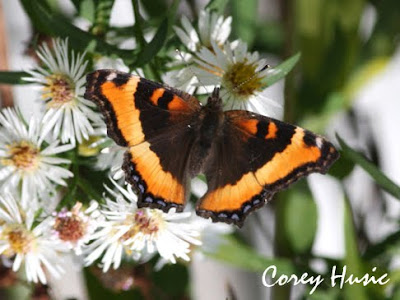
These beautiful insects can be hard to find, so coming across this species is always exciting. One of the best places to find this butterfly is at the Lehigh Gap Nature Center. The trails and gardens at the LGNC attract dozens of Milbert's Tortoiseshells every year. The native Aromatic Aster in the habitat gardens is a popular plant for many late-season butterflies especially this species.
For more information about the Milbert's Tortoiseshell, visit the Butterflies and Moths of North America website.

Sunday, September 19, 2010
Warblers
This weekend has been great for migrants. A strong push of birds came through after the passing of a cold front on Friday. Although Saturday was good, today was even better. Everywhere I looked, I found small flocks of warblers, vireos, and chickadees. At one point, I found 14 species in one tree. Of the warblers, Northern Parulas were the most abundant. Blackburnian and Black-throated Green Warblers were also fairly common. I found my first Yellow-rumped Warbler and Ruby-crowned Kinglet of the season this morning. Yesterday, I found my first White-throated Sparrow of the fall.


Northern Parulas, like this one, were everywhere this morning.

Blackburnian Warblers in the fall are not nearly as bright as they are in the spring, but they are still distinctive.
 This Monarch (NGL 300) has been tagged and is on its way to the over-wintering grounds in Mexico.
 Today, I photographed this Monarch flying overhead. If you look closely, you can see a MonarchWatch tag. This is probably a Monarch that I tagged in my yard that is now heading south.
Northern Parulas, like this one, were everywhere this morning.
Blackburnian Warblers in the fall are not nearly as bright as they are in the spring, but they are still distinctive.
Along with the birds, lots of Monarchs have been migrating. I have been able to tag a few for the MonarchWatch project, but most of the ones I see are flying.
 This Monarch (NGL 300) has been tagged and is on its way to the over-wintering grounds in Mexico.
 Today, I photographed this Monarch flying overhead. If you look closely, you can see a MonarchWatch tag. This is probably a Monarch that I tagged in my yard that is now heading south.
Tuesday, August 31, 2010
Birds in Flight
Are you interested in learning more about and how to identify birds in flight? Check out the Birds In Flight Project by clicking the logo below. Once on the page, browse the pages by clicking on the links under the "Pages" tab.

Monday, August 30, 2010
Veery Flight Call
Here is a spectogram of two Veery calls.

You can listen to a Veery flight call at the Lehigh Gap Nature Center's Sound Field Guide.
http://lgnc.org/resources/soundguide/veery

You can listen to a Veery flight call at the Lehigh Gap Nature Center's Sound Field Guide.
http://lgnc.org/resources/soundguide/veery
Sunday, August 29, 2010
Even More Birds in Flight
This morning I found 59 species in the yard, including Olive-sided Flycatcher and ten warbler species.
 American Robins are an abundant migrant in the fall. The flight pattern and the orange-red breast are distinctive.
 As I discussed yesterday, Eastern Kingbirds are abundant fall migrants. The neat thing about kingbirds is that they can be aged and, if an adult, sexed. The way to tell is by primaries 9 and 10, the "top" two feathers on the wingtips. In young birds, these feathers are blunt. In adult females, these feathers have a slight notch at the tip. In adult males, like the one above, the tips of these feathers are deeply notched.
 Flycatchers can sometimes be trick to identify when they are sitting. In flight they can be very difficult. This flycatcher shows broad white wing bars and no distinct eye-ring. Those characteristics, as well as the fact that it sang a "whisper song" while flying, make this an Eastern Wood-Pewee.
 Red-breasted Nuthatches have been very common migrants this year. I almost missed this one as it flew south over the yard. This species is fairly easy to identify in flight due to the distinctive pattern and the fact that they often call while flying.
 Although out of focus, this photo shows a common behavior of warblers that fly overhead. These two Black-throated Green Warblers spent a few seconds diving at and chasing eachother. The yellow-green body and tail pattern help the identification. I also heard a chip note as I was taking the photo.
 This bird called as it flew over, but I was unfamiliar with the call. Although the photo seems useless, it reveals the identity of the bird. This bird shows distinct striping down the side of the bird. Also, the front of the bird is brighter than the back. Finally, the pattern on the underside of the tail is visible. These characteristics make this a Cape May Warbler.
 American Robins are an abundant migrant in the fall. The flight pattern and the orange-red breast are distinctive.
 As I discussed yesterday, Eastern Kingbirds are abundant fall migrants. The neat thing about kingbirds is that they can be aged and, if an adult, sexed. The way to tell is by primaries 9 and 10, the "top" two feathers on the wingtips. In young birds, these feathers are blunt. In adult females, these feathers have a slight notch at the tip. In adult males, like the one above, the tips of these feathers are deeply notched.
 Flycatchers can sometimes be trick to identify when they are sitting. In flight they can be very difficult. This flycatcher shows broad white wing bars and no distinct eye-ring. Those characteristics, as well as the fact that it sang a "whisper song" while flying, make this an Eastern Wood-Pewee.
 Red-breasted Nuthatches have been very common migrants this year. I almost missed this one as it flew south over the yard. This species is fairly easy to identify in flight due to the distinctive pattern and the fact that they often call while flying.
 Although out of focus, this photo shows a common behavior of warblers that fly overhead. These two Black-throated Green Warblers spent a few seconds diving at and chasing eachother. The yellow-green body and tail pattern help the identification. I also heard a chip note as I was taking the photo.
 This bird called as it flew over, but I was unfamiliar with the call. Although the photo seems useless, it reveals the identity of the bird. This bird shows distinct striping down the side of the bird. Also, the front of the bird is brighter than the back. Finally, the pattern on the underside of the tail is visible. These characteristics make this a Cape May Warbler.
Subscribe to:
Posts (Atom)