Sunday, May 26, 2013

Maine Snaketail and other dragons

While attempting to photograph Indian Skippers on the property this afternoon (I did not succeed thanks to the strong wind), I noticed that there were quite a few dragonflies and damselflies out and about. Most of the damsels were bluets in the Northern/Vernal/Boreal species-group, which are not identifiable in the field. Although I was unable to identify them, I enjoyed watching them nervously fly between swaying blades of grass and occasionally perching on a sunny leaf or twig.


The most common dragonflies this afternoon were Common Whitetails, which will likely be the most abundant species throughout the summer months as well. It was slightly tricky to spot other species among the throngs of whitetails, but I managed to spot this Ashy Clubtail thanks to his flight style.


While I was observing the clubtail, he was dive-bombed by a Juvenal's Duskywing, a butterfly that seems to feel no fear when defending its territory against other butterflies, predatory insects, and even people! Although the clubtail disappeared after the incident with the butterfly, the pesky duskywing alerted me to the presence of another dragonfly that was perched just a few feet away:


This gorgeous odonate is a Painted Skimmer, a species that is fairly common this time of year in damp meadows. Its color and pattern is unique and definitely makes it stand out among the duller species! Unfortunately, Painted Skimmers tend to be skittish. I was only able to take a few photographs before he took flight and was out of sight.

Just as I headed back towards the house, I flushed another dragonfly off its perch. It flew different and looked strange compared to the others I had previously seen, so I followed it for a bit until it landed on the tip of a small greenbrier stem.


This gorgeous yellow, green, and black dragonfly is a Maine Snaketail, a new species for the yard. Typically, this species is found along streams, not ridgetop meadows. I can only imagine that this individual was engaging in "hill-topping," a mate-seeking behavior demonstrated by many insect species that often takes them out of their typical habitats. In fact, this is not the first time I have observed this behavior in this same meadow. Last May, I found an Uhler's Sundragon (a relatively rare species) in almost the same place as this year's snaketail.

A less-than-desirable photo of the Uhler's Sundragon I found in 2012

The fact that I found both of these species so far away from their typical stream habitats suggests that naturalists should always keep an open mind and be on the look-out for unexpected species. Who knows what is out there!
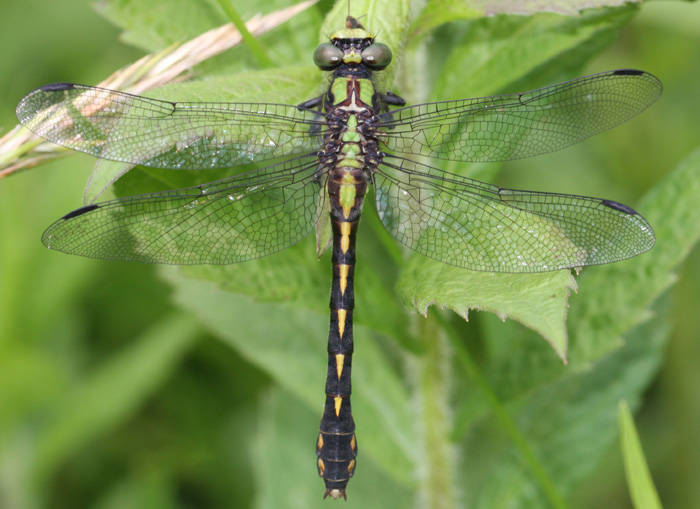
A Maine Snaketail that I found in 2011 in a more typical "northern" stream habitat in Sullivan Co., PA (State Game Lands #57)

Friday, May 24, 2013

Wilson's Warblers

The Wilson's Warbler is a relatively uncommon migrant warbler species in this region of Pennsylvania. In addition, their aptitude for staying in dense brush can make them difficult to find. I have discovered that the brushy edges and water sources in the yard provide excellent habitat for migrating Wilson's Warblers. Of the seven I have observed in the yard (including three this spring!), five have been from the same overgrown patch of greenbrier, spicebush, and highbush blueberry that shades a small muddy spring near the house.

male Wilson's Warbler staying hidden in the brush

the edge of the yard where I find the Wilson's Warblers
As I mentioned, this was an excellent spring for Wilson's Warblers, as I found three in my yard and another at the Lehigh Gap Nature Center in Carbon County. Maybe the relatively high number of this species has something to do with the weird migration this spring... who knows! Nevertheless, I don't mind having a few more of these singing in the yard for a couple days during migration.


This brushy area is also where I frequently find related species, such as this Canada Warbler. Like the Wilson's, it is unusual to find a Canada away from the dense brush. This bird popped up for no more than two seconds before disappearing back into the tangles.

Sunday, May 19, 2013

Double-check your sparrows!

Be sure to take a careful look at any sparrows you find during the migration season. When I saw this bird hopping around the garden and bathing in the bird bath, I figured it was a Song Sparrow. What a surprise when it turned out to be a Lincoln's Sparrowan uncommon species in this area!


Saturday, May 4, 2013

Cobwebs

My posts to this blog have been few and far between thanks to my busy schedule as I finish my senior year of high school. Today I finally had a chance to spend quite a bit of time outside and to enjoy the wonderful weather. Migrant birds--vireos, flycatchers, warblers--are beginning to return from their southern wintering grounds. A few new species showed up in the yard this morning, including Red-eyed Vireo and Baltimore Oriole.

A number of butterflies were also out enjoying the sunshine. Among the throngs of Juvenal's and Sleepy Duskywings, I found this lovely Cobweb Skipper, a species that can only be found for a few weeks each spring!


Monday, February 18, 2013

February Flowers

The ground is still frozen and patches of snow dot the landscape, but that hasn't kept the winter aconite from opening a few blooms in a sun-filled patch of the yard! These bright yellow flowers are almost always the first blossoms to appear each year—often around the middle of February.

winter aconite (Eranthis)
Serving as a reminder that spring is not far off, the aconite flowers mark the beginning of the blooming season, as other (mostly non-native) species will also begin to flower before long. Snowdrops, crocuses, and daffodils will soon brighten up the drab winter ground as the days continue to grow longer and the temperatures start to rise.

Saturday, February 16, 2013

Great Backyard Bird Count

This weekend (February 15-18) is the annual Great Backyard Bird Count, a citizen science event where birders are encouraged to submit their sightings in order to contribute to scientific research. Despite the name of the event, bird observations can be submitted from any birdy location, not just backyards. That said, everyone should take the time to see what species are visiting their feeders and gardens. To submit sightings, simply visit the GBBC website or eBird. Entering a checklist takes only a few minutes and will provide valuable data for researchers around the world.


As I write this, over 5,000,000 individual birds representing more than 1,700 species have been counted in the 2013 GBBC! Don't forget to contribute!

Wednesday, January 23, 2013

Northern Lapwings in New Jersey

On January 14, a lucky birder found a group of three Northern Lapwings in a cow pasture in New Egypt, NJ. On Sunday, my mom and I decided to go see these unusual plovers that had somehow made their way from Europe to central New Jersey. We when arrived at the location along Brynmore Road in New Egypt, we found a number of birders set up along the roadside with spotting scopes pointed into the field. As soon as we started scanning, we spotted one of the birds. Not long after, we found the other two even farther back.


Although the lapwings never came close while we were watching, we were able to get excellent views of the birds through a spotting scope. Even with the great distance from which we were watching, the green iridescence on the wings was spectacular!


Several times as we watched, one of the lapwings raised its large wings into the air. After doing this a few times, the bird flew into the air, circled around a few times, and then landed again.


These gorgeous rarities represented yet another "lifer" that my mom and I were able to see so far this year!