Friday, June 7, 2013

The Kestrels of State Game Lands #205

Last year, I wrote a about my experience banding American Kestrels in State Game Lands #205 in Lehigh County. I had a chance to return this past Tuesday to do some birding and check the nest boxes. The morning started out with a bird survey of the game lands that involved five-minute point counts at about twenty locations throughout the property. We found many common grassland bird species, including Field and Song Sparrows, Red-winged Blackbirds, Eastern Kingbirds, and Indigo Buntings. We also found a few less common species: Alder Flycatcher, Vesper and Grasshopper Sparrows, and Bobolink. The Bobolink and Vesper Sparrow were especially exciting, as these were species previously unrecorded in this game lands and are indicators of the excellent grassland habitat being created and managed there. For me, the singing Alder Flycatcher was intriguing, as there are very few known breeding territories of this species in Lehigh County.


After the bird survey, we checked on the nest boxes to determine the success of breeding kestrels this year.


All of the occupied nest boxes had chicks that were still too young to band, but we noted how many young and eggs were present in each nest.


Although the chicks were still too small for banding, we were able to capture several of the adult females. Most of these birds were unbanded, so we took measurements and placed a band around each bird's leg.


When we pulled the last bird of the day out of the nest box, we realized that she had was already banded and had a patagial tag, a type of wing marker used to identify individual birds without having them in the hand.


It turns out that this bird was banded as a chick in Warren County, NJ last June! One other adult female kestrel we caught was previously banded at the same location in New Jersey, but did not have a wing tag.

Based on the age of the young kestrels we saw, banding will take place in just a few weeks! All in all, the grassland songbird species we found in the morning and the many young kestrels we saw are good signs of a healthy grassland habitat that is sure to bring more birds in the future as the habitat matures and improves.

Thursday, June 6, 2013

Brook Snaketail -- Pennsylvania's First

The Pennsylvania Game Commission recently acquired a large tract of land on the north face of the Kittatinny Ridge in southern Monroe County. This property, once slated for development, contains a variety of habitats including a sedge and alder wetland that borders the Aquashicola Creek. This habitat looked like an excellent place to search for dragonflies, so I headed down there with my net and camera in hopes of finding some interesting species.

Sedges, cattails, and alders (in back)
While walking through the sedges, I found numerous Ashy Clubtails--a very common species this time of year:


The sedges also held many Calico Pennants and Twelve-spotted Skimmers. Once I worked my way through the sedges, I decided to focus my search close to the creek where it would be easier to see and catch the insects. Here I found many more Ashy Clubtails as well as hundreds of Ebony Jewelwings.

male Ebony Jewelwing--a type of damselfly
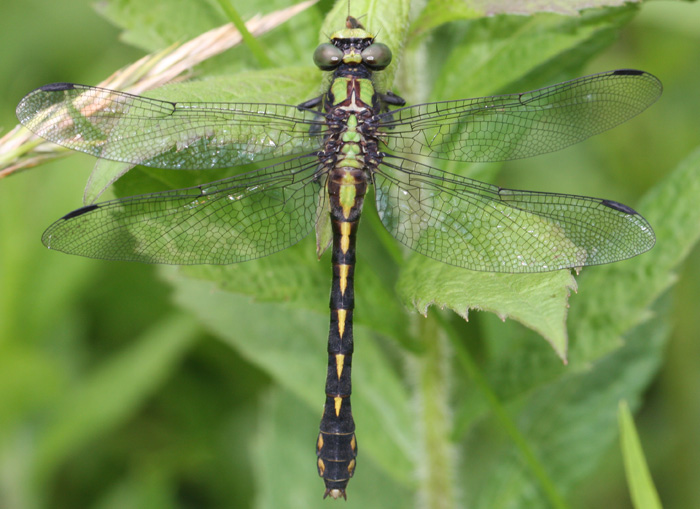
I soon spotted a large dragonfly with a distinctive green color, unlike the other species I had been seeing. I netted this individual in order to get a closer look:


This green, black, and yellow dragonfly is a Maine Snaketail, a species that inhabits rocky streams. This species is ranked as an S2S3 species within the state by the Pennsylvania Natural Heritage Program, which means that this is a rare species in Pennsylvania.

Not long after catching the Maine Snaketail, I spotted another dragonfly that appeared to be similar. In fact, when I saw it flying, I figured it might be of the same species. However, closer inspection suggested that was not the case.


The general appearance is very similar to that of the Maine Snaketail, but there are few differences in coloration and a distinct terminal appendage shape. Examination of the male's terminal appendages can be extremely helpful when identifying dragonflies. Notice the difference in shape of the appendages between the Maine Snaketail and this individual:

Maine Snaketail--note the two distinct "spines" on the lower appendage
On this snaketail, note the single spike on the lower appendage and the different shape of the upper
When I got home, I was able to research this species and determined it to be a Brook Snaketail (Ophiogomphus aspersus). After consulting a few experts, my identification was confirmed. I also discovered that this is a species that had never been recorded in the state of Pennsylvania before! 

I can't wait to get back to these game lands to see what other species may be hiding there!
Thursday, May 30, 2013

They're coming!

After several days of hearing and seeing a few periodical cicadas around the yard, the warm, muggy night of the 29th provided the perfect conditions for many more to emerge. This is what we found in the yard:


Sunday, May 26, 2013

Maine Snaketail and other dragons

While attempting to photograph Indian Skippers on the property this afternoon (I did not succeed thanks to the strong wind), I noticed that there were quite a few dragonflies and damselflies out and about. Most of the damsels were bluets in the Northern/Vernal/Boreal species-group, which are not identifiable in the field. Although I was unable to identify them, I enjoyed watching them nervously fly between swaying blades of grass and occasionally perching on a sunny leaf or twig.


The most common dragonflies this afternoon were Common Whitetails, which will likely be the most abundant species throughout the summer months as well. It was slightly tricky to spot other species among the throngs of whitetails, but I managed to spot this Ashy Clubtail thanks to his flight style.


While I was observing the clubtail, he was dive-bombed by a Juvenal's Duskywing, a butterfly that seems to feel no fear when defending its territory against other butterflies, predatory insects, and even people! Although the clubtail disappeared after the incident with the butterfly, the pesky duskywing alerted me to the presence of another dragonfly that was perched just a few feet away:


This gorgeous odonate is a Painted Skimmer, a species that is fairly common this time of year in damp meadows. Its color and pattern is unique and definitely makes it stand out among the duller species! Unfortunately, Painted Skimmers tend to be skittish. I was only able to take a few photographs before he took flight and was out of sight.

Just as I headed back towards the house, I flushed another dragonfly off its perch. It flew different and looked strange compared to the others I had previously seen, so I followed it for a bit until it landed on the tip of a small greenbrier stem.


This gorgeous yellow, green, and black dragonfly is a Maine Snaketail, a new species for the yard. Typically, this species is found along streams, not ridgetop meadows. I can only imagine that this individual was engaging in "hill-topping," a mate-seeking behavior demonstrated by many insect species that often takes them out of their typical habitats. In fact, this is not the first time I have observed this behavior in this same meadow. Last May, I found an Uhler's Sundragon (a relatively rare species) in almost the same place as this year's snaketail.

A less-than-desirable photo of the Uhler's Sundragon I found in 2012

The fact that I found both of these species so far away from their typical stream habitats suggests that naturalists should always keep an open mind and be on the look-out for unexpected species. Who knows what is out there!

A Maine Snaketail that I found in 2011 in a more typical "northern" stream habitat in Sullivan Co., PA (State Game Lands #57)

Friday, May 24, 2013

Wilson's Warblers

The Wilson's Warbler is a relatively uncommon migrant warbler species in this region of Pennsylvania. In addition, their aptitude for staying in dense brush can make them difficult to find. I have discovered that the brushy edges and water sources in the yard provide excellent habitat for migrating Wilson's Warblers. Of the seven I have observed in the yard (including three this spring!), five have been from the same overgrown patch of greenbrier, spicebush, and highbush blueberry that shades a small muddy spring near the house.

male Wilson's Warbler staying hidden in the brush

the edge of the yard where I find the Wilson's Warblers
As I mentioned, this was an excellent spring for Wilson's Warblers, as I found three in my yard and another at the Lehigh Gap Nature Center in Carbon County. Maybe the relatively high number of this species has something to do with the weird migration this spring... who knows! Nevertheless, I don't mind having a few more of these singing in the yard for a couple days during migration.


This brushy area is also where I frequently find related species, such as this Canada Warbler. Like the Wilson's, it is unusual to find a Canada away from the dense brush. This bird popped up for no more than two seconds before disappearing back into the tangles.

Sunday, May 19, 2013

Double-check your sparrows!

Be sure to take a careful look at any sparrows you find during the migration season. When I saw this bird hopping around the garden and bathing in the bird bath, I figured it was a Song Sparrow. What a surprise when it turned out to be a Lincoln's Sparrow—an uncommon species in this area!


Saturday, May 4, 2013

Cobwebs

My posts to this blog have been few and far between thanks to my busy schedule as I finish my senior year of high school. Today I finally had a chance to spend quite a bit of time outside and to enjoy the wonderful weather. Migrant birds--vireos, flycatchers, warblers--are beginning to return from their southern wintering grounds. A few new species showed up in the yard this morning, including Red-eyed Vireo and Baltimore Oriole.

A number of butterflies were also out enjoying the sunshine. Among the throngs of Juvenal's and Sleepy Duskywings, I found this lovely Cobweb Skipper, a species that can only be found for a few weeks each spring!